Skip to content
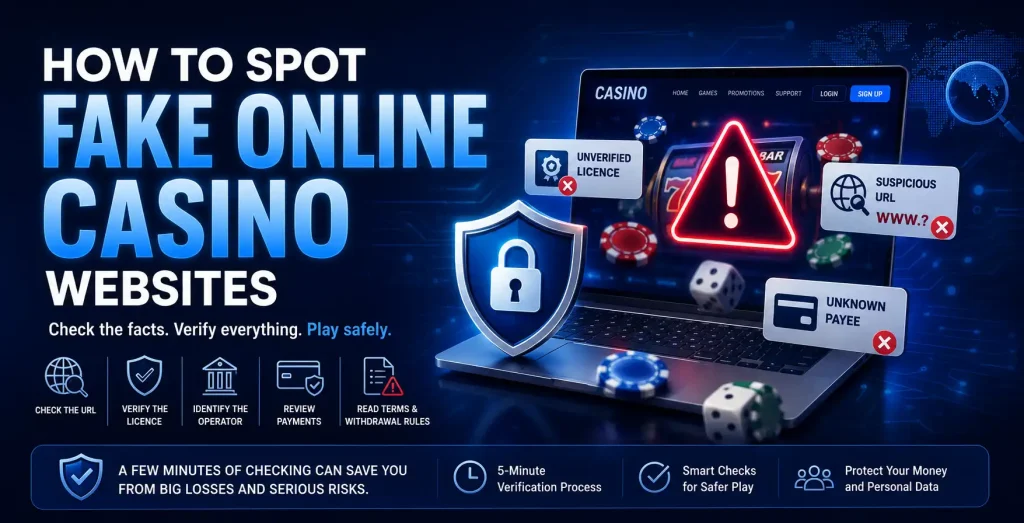
A fake online casino does not always look fake. Scam websites can use professional designs, copied game logos, HTTPS, live chat and convincing licence badges. Some may even copy the name and layout of a real gambling brand.
That is why checking whether a casino “looks trustworthy” is not enough. A better approach is to verify the website from the outside: check the domain, identify the company behind it, confirm any licence through an official regulator, review payment details and look closely at withdrawal conditions.
For users in Singapore, there is another important question: whether the service is authorised to provide remote gambling locally. An overseas licence and Singapore authorisation are not the same thing.
What Is a Fake Online Casino?
A fake online casino is a website that misleads users about who operates it, its licensing status, its games, payments or its ability to process withdrawals.
Not every suspicious gambling website works in the same way.
| Type | What It May Do |
| Fake casino | Pretends to be a legitimate gambling business |
| Cloned casino | Copies the name or design of another brand |
| Unlicensed operator | Provides gambling without required authorisation |
| Phishing site | Tries to steal passwords, banking details or personal data |
| Withdrawal scam | Accepts deposits but creates false reasons not to release money |
These categories can overlap. A cloned website, for example, may also use phishing pages and fake licence information.
The important point is that appearance alone cannot tell you which type of website you are dealing with.
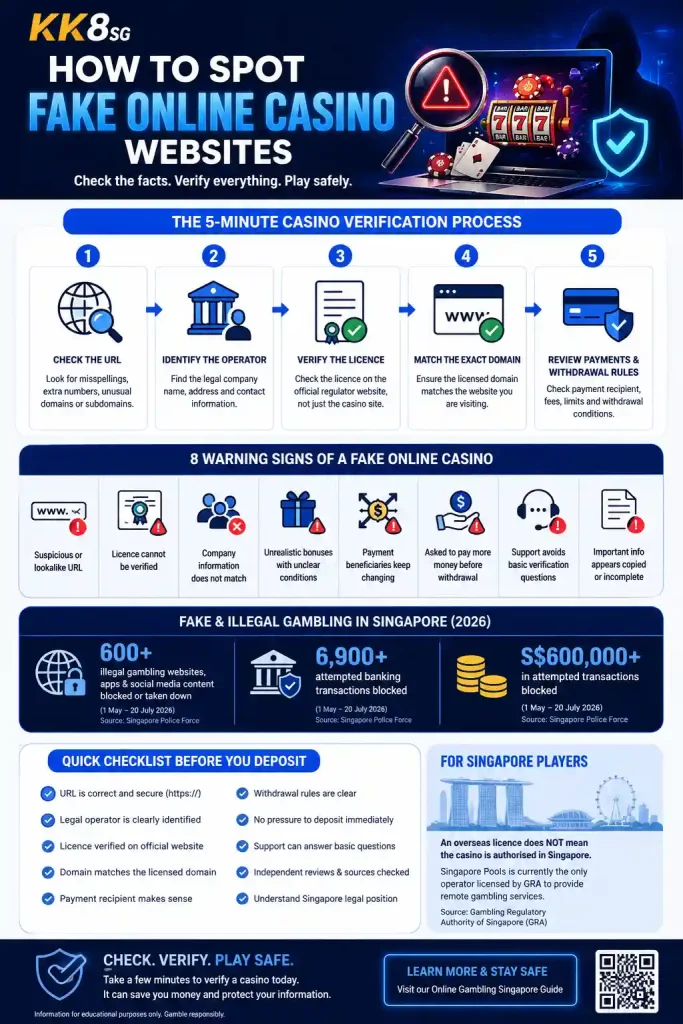
8 Warning Signs of a Fake Online Casino
Red flags should not automatically be treated as proof of fraud, but several warning signs appearing together deserve closer attention.
1. The Website Uses a Suspicious or Lookalike URL
Always read the full domain name rather than relying on the logo shown on the page.
A copied casino might use something similar to:
- brand-casino88.com
- brandsingapore.vip
- br4nd.com
- login.brand.example.com
ScamShield warns that spoofed website addresses are a common phishing warning sign.
Pay attention to:
- spelling changes;
- added numbers;
- unusual domain extensions;
- extra hyphens;
- misleading subdomains;
- links received through unsolicited messages.
If you discovered the site through Telegram, WhatsApp, SMS or an advertisement, search for the business separately instead of assuming the link is official.
2. The Gambling Licence Cannot Be Independently Verified
A licence badge is only an image until you verify it. Fake sites can copy regulator logos, licence numbers and even the names of real licensed companies.
If a casino claims to hold a licence, identify the regulator and open the regulator’s website separately. Search for the operator there rather than relying only on a page linked by the casino.
For example, the UK Gambling Commission’s public register allows searches by business name, trading name and domain name. It also shows licence status and registered domains.
This demonstrates an important principle:
Licence displayed ≠ licence verified.
3. The Company Information Does Not Match
Look at several parts of the website:
- footer;
- terms and conditions;
- privacy policy;
- licence page;
- responsible gambling page;
- contact page.
The same operating company should generally appear consistently.
Suppose the footer says the casino is operated by Company A, while its privacy policy says personal data is processed by Company B, and the licence number belongs to Company C.
That does not automatically prove fraud, because businesses can have several related companies. But unexplained inconsistencies are a reason to investigate before sending money or documents.
4. The Site Uses Bonuses to Create Pressure
A large bonus by itself does not prove that a casino is fake. The warning sign is usually the combination of an unusually large offer with unclear conditions and strong pressure to deposit immediately.
Be cautious when you see messages such as:
- “Deposit in the next 10 minutes.”
- “Guaranteed winnings.”
- “Risk-free casino.”
- “Withdraw your bonus immediately.”
- “Exclusive bonus only available through this link.”
Read the bonus terms, withdrawal requirements and eligibility rules rather than judging the offer by the headline.
5. Payment Beneficiaries Keep Changing Without Explanation
The payment step can reveal information that the casino homepage does not. Before making a PayNow or bank transfer, check who is receiving the money.
Questions worth asking include:
- Does the beneficiary name make sense?
- Is the payment going to an unrelated person?
- Has support suddenly provided another account?
- Does the receiving account change repeatedly?
- Can support clearly explain who processes the payment?
Singapore Police investigations into illegal gambling have included the misuse of personal and corporate bank accounts to facilitate gambling-related transactions.
A changing beneficiary does not by itself prove that a casino is fake, because some businesses use payment processors. But unexplained changes should not be ignored.
6. You Are Asked to Pay More Money Before a Withdrawal
This deserves special attention.Imagine that a user deposits $200 and later tries to withdraw $1,500. Support then says another $300 must be deposited to “unlock” the withdrawal.
Possible explanations might include:
- verification fee;
- withdrawal tax;
- security deposit;
- account activation fee;
- clearance fee.
Do not automatically make another payment.
Instead, check whether the fee appeared clearly in the site’s terms before the withdrawal was requested and whether it makes sense under the rules that supposedly apply to the operator.
Repeated demands for new payments are a serious warning sign.
7. Support Avoids Basic Verification Questions
Good customer support is not proof that a casino is genuine. Fake sites can operate live-chat systems too. A more useful test is the type of information support can provide.
Ask simple questions such as:
- What legal company operates this website?
- Which regulator issued your licence?
- What is the licence number?
- Where can I verify it independently?
- Which company processes deposits?
- Where are withdrawal fees explained?
If support repeatedly avoids these questions or gives different answers each time, investigate further.
8. Important Information Appears Copied or Incomplete
Check whether the site’s legal pages actually describe the casino you are visiting.
Copied pages sometimes contain:
- another casino’s name;
- incorrect company details;
- broken regulator links;
- placeholder text;
- conflicting withdrawal rules;
- old domains.
A polished homepage means little if the legal pages tell a different story.
How to Verify an Online Casino Website in 5 Minutes

Instead of judging a casino by its design, use a repeatable verification process.
Step 1: Check the Exact Website Address
Start with the domain shown in your browser. Compare it with the website address shown by independent sources, where available.
Look carefully for:
- misspellings;
- extra words;
- added numbers;
- strange subdomains;
- unusual redirects.
You can also check basic domain information such as when the domain was registered. A very new domain claiming to have operated for 15 years would deserve more investigation.
However, domain age should only be treated as supporting evidence. Old domains can be misused and legitimate businesses can launch new domains.
Step 2: Identify the Company Behind the Website
Do not stop at the casino brand name. Find the legal operator. A legitimate business should normally provide enough information for users to understand who operates the service.
Record:
| Information | What to Check |
| Casino brand | Does the name stay consistent? |
| Legal company | Is an operator clearly identified? |
| Address | Does it match other official records? |
| Licence number | Can it be independently searched? |
| Regulator | Is it a real regulatory authority? |
| Domain | Does the regulator recognise this website? |
The goal is not simply to collect these details. It is to see whether they match.
Step 3: Verify the Gambling Licence Independently
If a regulator is named, open the regulator’s official website yourself. Do not rely only on a casino badge or screenshot.
Where a public register is available, check:
- legal company name;
- trading name;
- licence number;
- licence status;
- authorised activities;
- registered website domain.
For example, the UK Gambling Commission register lists legal business names, trading names, domains and current licence status.
A licence belonging to a real company does not automatically prove that the website you are visiting belongs to that company. That leads to the next check.
Step 4: Match the Licence to the Exact Domain
This is one of the most important steps and one that users often miss.
Imagine that:
ExampleCasino.com
is genuinely operated by a licensed company.
A scammer could create:
ExampleCasino-SG88.com
and copy the real company’s logo, company name and licence number.
Searching only the licence number could therefore create false confidence. Whenever the regulator provides domain information, verify the actual website as well.
Think of the check as four matching pieces:
Company + Brand + Licence + Domain
If one part does not match, investigate why.
Step 5: Review Payments and Withdrawal Rules
Do this before depositing, not after winning.
Read:
- minimum deposit;
- withdrawal limits;
- processing times;
- identity verification rules;
- bonus wagering terms;
- withdrawal fees;
- payment methods.
Then compare those rules with what support tells you.
For example, if the published terms say withdrawals are free but support later demands a large “release fee,” that inconsistency deserves attention.
How Singapore Users Should Check an Online Casino
For Singapore users, website verification and legal status are separate issues. A website may genuinely belong to a company that holds an overseas gambling licence, but that does not automatically mean the operator is authorised to offer remote gambling services to people in Singapore.
That means users should separate these questions:
| Question | What It Actually Tells You |
| Does the casino look professional? | Only its presentation |
| Does it use HTTPS? | The connection is encrypted |
| Does it claim an overseas licence? | Its claimed overseas regulatory status |
| Can the licence be verified? | Whether the licence claim is supported |
| Is the exact domain registered? | Whether that website matches the licence |
| Is it authorised in Singapore? | Its local regulatory status |
An Overseas Licence Does Not Equal Singapore Authorisation
This distinction is important.
A casino may truthfully state that it holds a licence issued somewhere else. That claim should still be verified, but even a real overseas licence should not be treated as proof that the service is authorised for users in Singapore.
For local legal status, use information from Singapore authorities rather than relying on the casino’s marketing language.
Does HTTPS Mean an Online Casino Is Safe?
No. HTTPS is useful, but its role is often misunderstood.
When a website uses HTTPS, information sent between your browser and the website is encrypted. That helps protect the connection.
It does not prove that:
- the casino licence is real;
- the operator is trustworthy;
- withdrawals will be paid;
- the company information is accurate;
- the website is authorised in Singapore.
ScamShield recommends checking for HTTPS as a security precaution but also warns users about spoofed website addresses and malicious links.
A fake website can therefore have HTTPS.
Think of HTTPS as one security feature, not a certificate of honesty.
Should You Trust Online Casino Reviews?
Reviews are useful as supporting evidence, but they should not replace independent checks.
Be cautious when a casino has:
- hundreds of very similar five-star reviews;
- reviews posted within a short period;
- no detailed complaints;
- review pages that contain only promotional links;
- claims that cannot be checked anywhere else.
At the same time, one negative review does not prove that a casino is fraudulent. Payment disputes can have many causes, including incomplete verification or breached bonus terms.
Look for patterns rather than single comments.
For example, ten unrelated users reporting the same unexpected withdrawal fee is more meaningful than one person writing “this casino is a scam” without explaining what happened.
Why Professional Design Is a Weak Trust Signal
Years ago, obvious scam websites often contained broken pages, poor images and large spelling errors. That is no longer a reliable test.
Modern website templates allow almost anyone to build a polished site. Logos, game images, terms and even customer reviews can be copied.
For that reason, trust signals can be ranked roughly like this:
| Signal | Strength |
| Independent official regulatory record | Strong |
| Exact licensed domain match | Strong |
| Matching legal operator information | Strong |
| Consistent payment information | Medium to strong |
| Clear withdrawal terms | Medium |
| Independent reputation | Medium |
| HTTPS | Basic |
| Attractive design | Weak |
A website’s appearance should be one of the last things you use to judge its legitimacy, not the first.
A Simple Fake Online Casino Checklist

Before sharing money, banking details or identification, run through this list.
| Check | Question to Ask |
| URL | Am I on the exact website I intended to visit? |
| Operator | Can I identify the legal company? |
| Licence | Did I verify it through the regulator? |
| Domain | Does the registered domain match this site? |
| Singapore status | Is the service authorised locally? |
| Payment | Do I understand who receives the money? |
| Terms | Are withdrawal rules clearly explained? |
| Support | Can staff answer basic regulatory questions? |
| Security | Is HTTPS present and is the URL correct? |
| Independent checks | Do outside sources support the site’s claims? |
If several answers are unclear, do more research before continuing.
Final Takeaway
The best way to spot a fake online casino is not to look for one magic warning sign.
A professional design can be copied. HTTPS can exist on a scam website. A licence logo can be copied from another operator. Reviews can be manipulated.
The stronger method is to verify several facts independently:
check the URL, identify the operator, verify the licence, match the exact domain, review the payment recipient and read the withdrawal terms.
For users in Singapore, also check the local legal position separately. An overseas licence does not automatically mean that a remote gambling service is authorised in Singapore.
For a broader look at gambling rules, payments, website safety and player protection, explore our Online Gambling Singapore Guide.
Frequently Asked Questions
How can I tell if an online casino is fake?
Check the website address, legal operator, gambling licence, registered domain, payment details and withdrawal rules. Do not rely only on the site’s appearance, licence badge or customer reviews.
Can a fake online casino have HTTPS?
Yes. HTTPS encrypts the connection between your browser and the website, but it does not prove that the company operating the site is legitimate. Always verify the operator and licence separately.
How do I check an online casino licence?
Identify the regulator named by the casino and visit that regulator’s official website independently. If it provides a public register, search for the company, licence status, trading name and exact domain.
Can a fake casino copy a real gambling licence?
Yes. A fake website can copy a real company’s licence number or regulator logo. This is why you should check whether the licence belongs to the company and exact domain you are visiting.
Is being asked to deposit again before a withdrawal a red flag?
It can be. If a casino unexpectedly asks for another deposit, activation fee, tax or security payment before releasing a withdrawal, stop and check the published terms and operator details before sending more money.
How can I identify a cloned casino website?
Compare the exact domain with independent records. Look for misspellings, additional numbers, unusual domain extensions and inconsistencies in the operator’s legal information.
Does an overseas casino licence make a site legal in Singapore?
Not automatically. Overseas licensing and Singapore authorisation are separate matters. GRA states that Singapore Pools is currently the only operator licensed by GRA to provide remote gambling services in Singapore.
What should I do if I have already sent money to a suspicious casino?
Stop further payments, save transaction records and communications, contact your bank or payment provider, secure any accounts whose passwords or financial details may have been exposed, and use official reporting channels where appropriate.