Skip to content
Online gambling refers to gambling activities carried out through websites, mobile apps, or other internet-connected services. Instead of visiting a physical casino, betting shop, or gaming venue, users access gambling products digitally and place wagers through an online account.
Common types of online gambling include casino games, sports betting, lotteries, and other wagering products. The exact services available depend on the operator, payment system, technology, and local regulations.
For Singapore users, there is an important legal distinction between licensed and unlicensed remote gambling. The Gambling Regulatory Authority (GRA), a statutory board under the Ministry of Home Affairs formed on 1 August 2022, states that Singapore Pools is the only operator licensed by GRA to provide remote gambling services in Singapore. Participating in unlicensed remote gambling is also an offence.
This matters more than it might first appear. NCPG’s 2023 survey found that 92% of Singapore residents who gambled used a legal channel such as Singapore Pools, while about 1% reported taking part in illegal online gambling, up from 0.3% in 2020. Understanding what counts as licensed activity is the first practical step for any Singapore user looking into online gambling.
For a broader overview of the topic, visit our Online Gambling Singapore Guide.
Quick Answer
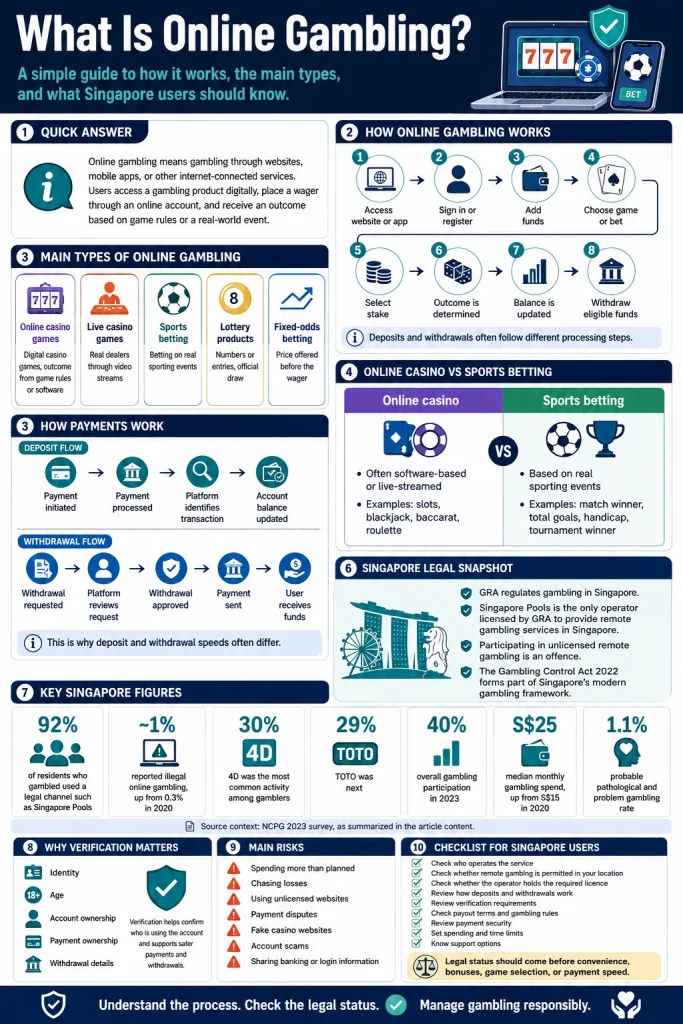
The simplest online gambling meaning is gambling conducted through the internet. A player accesses an online service, selects a gambling product, places a stake, and receives an outcome according to the rules of the game or event.
Different forms work in different ways. Online slots and some casino games use software to determine outcomes, live casino games use streamed tables with human dealers, while sports betting depends on the outcome of real sporting events.
In Singapore, online gambling also falls within the country’s remote gambling framework. GRA regulates gambling under the Gambling Regulatory Authority Act 2022, the Gambling Control Act 2022, and the Casino Control Act 2006. The Gambling Control Act 2022 consolidated earlier legislation, including the former Remote Gambling Act 2014, into a single modern framework covering both land-based and remote gambling.
How Does Online Gambling Work?
Most online gambling platforms follow a similar basic process. The exact details differ by operator and gambling product.
A typical journey looks like this:
A user creates or accesses an account. The user selects a game or betting product. Funds are deposited or otherwise made available for wagering. The user selects a stake. The game or event determines the result. Winnings, if any, are added to the account balance. Eligible funds are withdrawn according to the operator’s rules.
Several systems work behind the scenes, including account management, payments, game software, security controls, transaction records, and withdrawal processing.
For a more detailed breakdown, read How Online Gambling Works.
What Are the Main Types of Online Gambling?
The term online gambling covers several different activities rather than one single product.
| Type | How It Works | Typical Outcome Source |
|---|---|---|
| Online casino games | Players wager on digital casino games | Game rules or software |
| Live casino games | Real dealers run games through video streams | Physical table outcome |
| Sports betting | Players wager on sporting events | Real event result |
| Lottery products | Players select numbers or entries | Official draw |
| Fixed-odds betting | A price is offered before the wager | Event result |
Some remote games also include chance-based elements where players might win items or prizes of value. GRA separately addresses remote games of chance under its class licensing framework.
Among Singapore’s legal gambling options, lottery-style products remain the most widely used. NCPG’s 2023 survey found 4D was the most common activity among gamblers, reported by 30% of respondents, followed closely by TOTO at 29%.
For a full explanation of each category, see Types of Online Gambling Explained.
Online Casino Games
Online casino games reproduce or adapt traditional casino formats for digital use.
Common examples include:
Slots Blackjack Baccarat Roulette Table games Live dealer games
Some games are generated entirely through software. Others use live video streams from physical tables.
The way an outcome is generated depends on the game type. This is why understanding the difference between RNG-based games and live casino games matters.
Read Live Casino vs RNG Games for a direct comparison.
Sports Betting
Sports betting involves placing a wager on the result or occurrence of an event within a sporting competition.
Examples include:
Match winner Total goals Correct score Handicap markets Tournament winner
Unlike casino games, the outcome comes from a real-world sporting event rather than a game program or casino table.
This difference is one reason users often compare online casinos and sportsbooks separately.
Read Online Casino vs Sports Betting for more detail.
How Online Gambling Accounts Work
Online gambling generally requires some form of user account.
An account keeps track of information such as:
Account balance Deposits Withdrawals Bets Game activity Bonuses Verification status Account limits
Account requirements differ between operators.
Some regulated services also require age checks, identity verification, payment verification, or responsible gambling controls.
In Singapore, Singapore Pools’ licensed remote gambling service is required to implement responsible gambling measures including monthly expenditure and funding limits, usage information, and alerts as users approach expenditure limits.
How Online Gambling Payments Work
Payments connect the player’s bank, card, wallet, or other supported payment method with the online gambling account.
A deposit generally follows this sequence:
Payment initiated > Payment processed > Platform identifies transaction > Account balance updated
A withdrawal follows a different path:
Withdrawal requested > Platform reviews request > Withdrawal approved > Payment sent > User receives funds
This explains why deposit and withdrawal speeds often differ even when the same payment method is involved.
Read How Online Casino Deposits Work for the deposit process.
What Payment Methods Are Used for Online Gambling?
Online platforms might support different payment methods depending on the market and operator.
Common digital payment categories include:
Bank transfers Real-time payments Cards E-wallets Mobile payments
For Singapore users, PayNow is a familiar real-time payment service used for SGD transfers through participating financial institutions.
Payment availability does not determine whether a gambling service is lawful. A platform accepting a familiar Singapore payment method should not be treated as proof of licensing. In fact, GRA can direct financial institutions to block payment transactions linked to unlawful gambling operators, so a payment method being available on a site is not a signal of legitimacy either way.
If you are comparing payment methods, read PayNow vs Other Payment Methods.
What Is Remote Gambling?
Remote gambling is a broader regulatory term used for gambling conducted through remote communication.
Online gambling is one common form because users participate through websites, mobile devices, or online services rather than being physically present at the gambling venue.
For Singapore users, the distinction matters because GRA specifically regulates remote gambling. GRA states that providing unlicensed remote gambling services in Singapore, from Singapore, or from overseas to people located in Singapore is unlawful.
You can explore this topic further in Remote Gambling in Singapore Explained.
Is Online Gambling Legal in Singapore?
Online gambling Singapore rules are more restrictive than simply asking whether a website is accessible.
GRA states that Singapore Pools is the only operator licensed to provide remote gambling services in Singapore. It is unlawful for another operator to provide unlicensed remote gambling services to people situated in Singapore. It is also an offence for a person in Singapore to participate in unlicensed remote gambling.
Since 1 January 2025, the Singapore Police Force has taken over functions involving the blocking of unlawful remote gambling websites, advertising, and payment transactions. In 2023, police arrested more than 450 individuals for illegal gambling, roughly a third of whom were involved with online platforms, underlining that enforcement against unlicensed remote gambling is an active, ongoing effort rather than a rule that exists only on paper.
For the detailed legal framework, read Is Online Gambling Legal in Singapore?
How Online Gambling Differs From Physical Gambling
The gambling principle is similar, but the user experience differs.
| Area | Online Gambling | Physical Gambling |
|---|---|---|
| Access | Website or app | Physical venue |
| Payments | Digital payments | Cash and electronic methods |
| Games | Software or streamed games | Physical tables or machines |
| Account | Usually account-based | Depends on venue |
| Availability | Depends on service access | Depends on venue hours |
| Transaction records | Often stored digitally | Varies |
| Verification | Digital account checks | Physical or account checks |
Online access removes the need to travel to a venue, but it also changes how users manage time, money, account access, and transaction records.
How RNG Online Gambling Works
Many digital casino games rely on a random number generator, often called an RNG.
An RNG generates values used by the game software to determine outcomes according to the game’s rules.
For example, an online slot uses its underlying game system to determine the symbols shown after a spin. The visual animation displays the result but does not necessarily create the randomness itself.
RNG-based games differ from live dealer games, where outcomes come from physical cards, wheels, or other equipment used during a streamed game.
Our Live Casino vs RNG Games guide covers the differences in more detail.
What Is RTP?
RTP stands for return to player.
It is a mathematical percentage describing how much a game is designed to return to players collectively over a long period of play.
For example, a theoretical RTP of 96% does not mean a player who wagers SGD100 receives SGD96 back. It describes a long-run statistical model across many rounds.
Individual sessions vary because outcomes occur separately.
RTP should therefore not be treated as a prediction of your personal result.
Why Verification Matters in Online Gambling
Verification helps an operator confirm information related to an account.
Depending on the service, verification might include:
Identity Age Account ownership Payment ownership Withdrawal details
Verification also plays a role in online gambling security. Users should know which operator they are dealing with, how their account information is handled, and whether the service is licensed where required.
For practical checks, see How to Verify an Online Casino.
What Are the Main Risks of Online Gambling?
Online gambling involves financial risk because outcomes are uncertain and losses are possible.
Other risks include:
Spending more than planned Chasing losses Spending long periods gambling Using unlicensed gambling websites Payment disputes Fake casino websites Account scams Sharing banking or login information
The scale of this risk in Singapore is measurable. NCPG’s 2023 survey, based on interviews with 3,007 residents aged 18 and above, found that while overall gambling participation has fallen to 40%, its lowest level since the survey began in 2005, median monthly gambling expenditure among those who do gamble rose to $25, up from $15 in 2020. The probable pathological and problem gambling rate has stayed low and stable at 1.1% across recent survey years, but the council notes this does not make individual harm any less serious for those affected.
Singapore’s National Council on Problem Gambling describes responsible gambling as managing gambling behavior through self-control, balancing gambling with other activities, setting time limits, and setting a gambling budget.
For online safety issues, read Common Online Gambling Scams.
How to Recognise a Fake Online Gambling Website
A professional-looking website does not prove a gambling operator is trustworthy or licensed.
Common warning signs include:
Unclear operator information False regulatory claims Unusual payment requests Requests for passwords or banking credentials Missing withdrawal rules Inconsistent website information Pressure to deposit quickly Unclear customer support
In Singapore, the key regulatory check is whether remote gambling activity is licensed under the applicable framework. GRA identifies Singapore Pools as the only licensed remote gambling operator.
See How to Spot Fake Online Casino Websites for a detailed checklist.
Online Gambling Explained in One Process
The basic online gambling process is easier to understand when separated into stages.
| Stage | What Happens |
|---|---|
| Access | User enters website or app |
| Account | User signs in or registers |
| Funding | Funds become available for gambling |
| Selection | User chooses a game or wager |
| Stake | User chooses the amount |
| Outcome | Game or event determines result |
| Settlement | Winnings or losses update the balance |
| Withdrawal | Eligible funds are requested for payout |
This process applies broadly, though individual products and operators differ.
Online Gambling Checklist for Singapore Users
Before using any online gambling service, review:
Who operates the service Whether remote gambling is permitted in your location Whether the operator holds the required licence How deposits and withdrawals work Account verification requirements Gambling rules and payout terms Payment security Spending limits Time limits Support options
Legal status should come before convenience, bonuses, game selection, or payment speed.
Frequently Asked Questions
What is online gambling?
Online gambling means participating in gambling activities through internet-based services such as websites or mobile applications. Products might include casino games, sports betting, lotteries, and other forms of remote wagering.
How does online gambling work?
Users generally access an account, fund it, select a game or wager, choose a stake, receive an outcome, and have winnings or losses reflected in the account balance. Withdrawals follow a separate approval and payment process.
What are the main types of online gambling?
Common types include online casino games, live casino games, sports betting, lottery products, and other remote wagering formats.
Is online gambling legal in Singapore?
Licensed remote gambling is tightly restricted. GRA states that Singapore Pools is the only operator licensed to provide remote gambling services in Singapore, and participating in unlicensed remote gambling is an offence.
What is the difference between online gambling and remote gambling?
Online gambling refers specifically to gambling through internet-based services. Remote gambling is a wider regulatory concept covering gambling conducted through remote communication rather than physical presence.