Skip to content
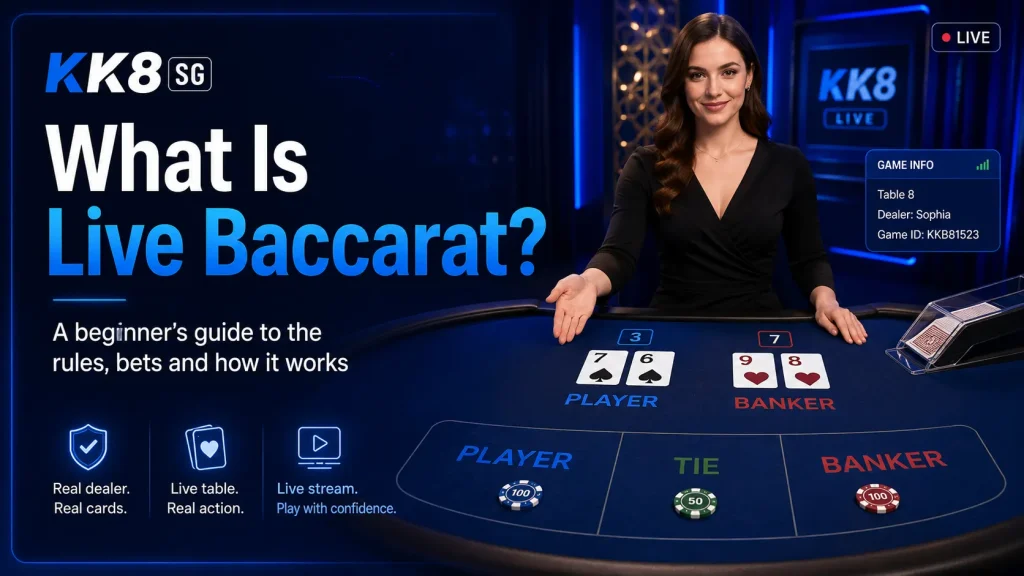
Live baccarat is baccarat played at a physical gaming table with a real dealer while the action is shown through a live video feed. Instead of receiving your own hand, you place a wager on one of two hands, called Player and Banker, or on the two hands finishing with the same score, called a Tie.
The main objective is simple. The hand with a score closest to nine wins. You choose your wager and stake, while fixed baccarat rules determine how the cards are dealt and whether either hand receives a third card. You do not make hit-or-stand decisions as you would in blackjack. Standard baccarat rules use Player and Banker as names for the two hands, not descriptions of you and the casino dealer.
What Is Live Baccarat?
Live baccarat combines a physical baccarat game with a digital betting interface. A dealer handles real cards at a studio or casino table, while players watch the round through a video stream and place wagers through an on-screen interface.
A typical screen includes the live video, betting areas for Player, Banker and Tie, a countdown timer, chip values, previous results and, on many tables, baccarat roadmaps.
The important distinction is the method of delivery. The dealer and cards are physical, while your wager is recorded through the digital interface. The underlying baccarat rules still determine the outcome.
How Does Live Baccarat Work?
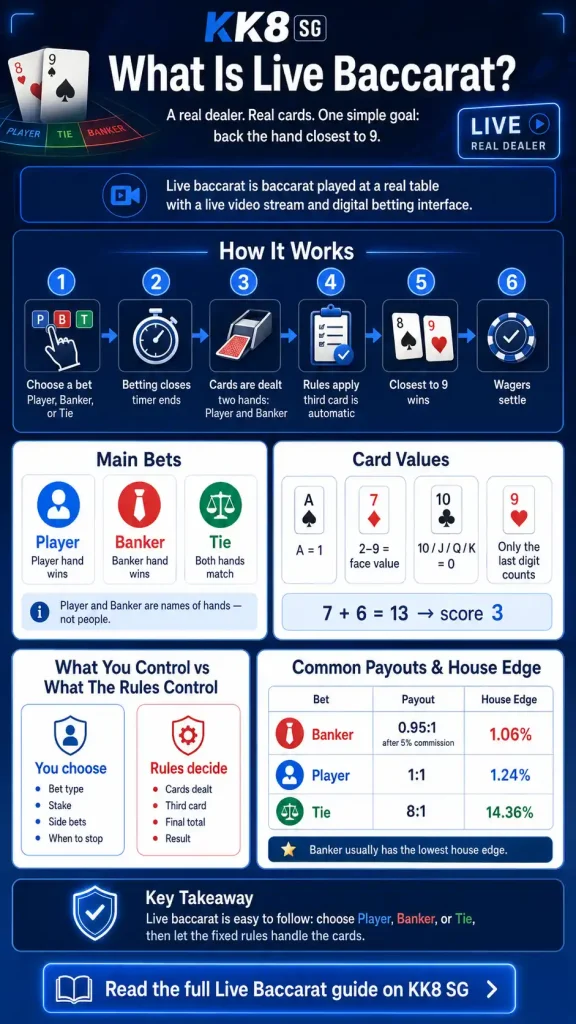
1. Choose Your Bet
| Bet | What You Are Betting On |
| Player | The Player hand finishes closer to 9 |
| Banker | The Banker hand finishes closer to 9 |
| Tie | Both hands finish with the same total |
2. The Betting Window Closes
Live baccarat tables use a betting period before each round. Once the timer ends, the interface stops accepting wagers for the current round. The dealer then starts dealing.
3. Player and Banker Receive Two Cards
Two cards are dealt to the Player hand and two to the Banker hand. Standard baccarat commonly uses multiple decks, with eight-deck analysis frequently used when comparing baccarat probabilities.
You do not receive a personal hand. Player and Banker are simply the names given to the two hands on the table.
4. Baccarat Drawing Rules Apply
A third card is sometimes dealt, but you do not choose whether either hand takes another card.
If either hand has a natural 8 or 9 from its first two cards, both hands stand. Otherwise, the Player hand draws on totals of 0 to 5 and stands on 6 or 7. The Banker rules depend on its own total and, in some situations, the Player’s third card.
This sounds more complicated than the player’s role actually is. The dealer and game system apply the drawing rules for you.
5. The Winning Hand Is Determined
The hand finishing closest to nine wins.
If Player and Banker finish with the same total, the round is a Tie. Standard Player and Banker wagers push when this happens, while a successful Tie wager receives its stated payout.
6. The Wager Is Settled
Once the result is confirmed, the interface settles the wagers and prepares for the next betting window.
What Do Player, Banker and Tie Mean in Baccarat?

These terms cause more confusion than the rules themselves. Player does not mean you. Banker does not mean the dealer or casino.
They are two separate hands used to determine the result of each baccarat round. Standard baccarat rules refer to Player and Banker as both hands and betting options.
Think of the decision as predicting an outcome rather than playing a hand yourself. For example, suppose you place S$20 on Player.
Player finishes with 8.
Banker finishes with 6.
Player wins, so your Player wager wins.
You did not own the Player cards. You simply backed the Player hand to finish with the higher baccarat score.
How Are Baccarat Cards Scored?
Baccarat uses an unusual scoring system, but it takes little time to learn.
| Card | Baccarat Value |
| Ace | 1 |
| 2 to 9 | Face value |
| 10 | 0 |
| Jack | 0 |
| Queen | 0 |
| King | 0 |
Standard baccarat gives Ace a value of one, cards 2 through 9 their printed value, and tens and face cards a value of zero. Only the final digit of the total matters.
Example 1:
7 + 6 = 13
Baccarat score = 3
Example 2:
9 + 8 = 17
Baccarat score = 7
Example 3:
King + 8 = 8
Baccarat score = 8
There is no score above nine.
What Is a Natural in Baccarat?
A natural occurs when the first two cards give Player or Banker a total of eight or nine. If either hand has a natural, the normal baccarat rules stop both hands from drawing another card.
For example:
Player: 4 + 4 = 8
Banker: 3 + 2 = 5
Player has a natural 8. No third card is dealt, and Player wins.
Who Decides Whether a Third Card Is Drawn?
The baccarat rules decide. This is an important difference between baccarat and games such as blackjack. You do not choose to hit, stand or request another card.
The Player rule is straightforward. Outside a natural:
| Player Total | Action |
| 0 to 5 | Draw |
| 6 to 7 | Stand |
| 8 to 9 | Natural, both hands stand |
If Player stands on 6 or 7, Banker draws on 0 to 5 and stands on 6 or 7. If Player receives a third card, the Banker drawing rule also considers the value of that card.
A beginner does not need to memorise the full Banker matrix to play a standard baccarat round. The dealer follows it automatically.
A useful way to think about baccarat is to separate your decisions from the game’s decisions.
| You Control | Baccarat Rules Control |
| Where you wager | Cards dealt |
| Your stake | Third-card decisions |
| Whether you choose a side bet | Hand totals |
| Whether you continue playing | Round result |
What Are the Payouts and House Edge in Live Baccarat?
Payouts depend on the table rules, so check the paytable before treating any figures as universal.
For a common eight-deck baccarat structure with a 5% Banker commission and an 8:1 Tie payout, the mathematical house edges are approximately 1.06% for Banker, 1.24% for Player and 14.36% for Tie.
| Bet | Common Payout Structure | Approx. House Edge |
| Banker | 0.95:1 after 5% commission | 1.06% |
| Player | 1:1 | 1.24% |
| Tie | 8:1 | 14.36% |
These percentages describe long-run mathematical expectation, not what will happen during one round or one session.
To make the difference easier to understand, consider S$100 of theoretical wagering.
| Bet | House Edge | Theoretical Average Loss per S$100 Wagered |
| Banker | 1.06% | About S$1.06 |
| Player | 1.24% | About S$1.24 |
| Tie | 14.36% | About S$14.36 |
This does not mean a S$100 Banker wager loses S$1.06 each time. Individual rounds result in wins, losses or pushes. House edge describes the mathematical average across a large number of wagers.
For a deeper explanation of this concept, see our RTP and casino mathematics guide.
Why Does the Banker Bet Charge Commission?
The Banker hand has a small structural advantage because its drawing rules act after more information about the Player hand is available. Standard baccarat offsets this advantage by paying a winning Banker bet at 19:20, equivalent to even money minus a 5% commission.
Here is a simple example.
You wager S$100 on Player and Player wins.
Profit: S$100.
You wager S$100 on Banker under a standard 5% commission table and Banker wins.
Profit before commission: S$100.
Commission: S$5.
Net profit: S$95.
This commission structure helps explain why Banker still has a slightly lower house edge than Player despite its reduced winning payout.
What Is No Commission Baccarat?
No Commission Baccarat removes the standard 5% commission from winning Banker wagers, but the name does not mean every Banker result pays full even money.
Instead, the paytable usually modifies one or more outcomes.
One widely analysed version pays most Banker wins at 1:1 but reduces a Banker win with a total of six to 1:2. Under an eight-deck model, this version gives the Banker bet a house edge of about 1.46%.
For a S$100 Banker wager:
Normal Banker win:
S$100 profit.
Banker wins with 6:
S$50 profit under this specific version.
Compare this with a standard commission game:
| Feature | Standard Baccarat | Example No Commission Version |
| Banker commission | Usually 5% | None |
| Most Banker wins | 0.95:1 | 1:1 |
| Banker win with 6 | Standard Banker payout | 0.5:1 |
| Banker house edge | About 1.06% | About 1.46% |
Different no-commission formats use different rules. Read the table paytable before comparing two games based only on their names.
Singapore’s Gambling Regulatory Authority also lists Baccarat and No Commission Baccarat among approved Marina Bay Sands baccarat game rules.
What Are Baccarat Roadmaps?

Live baccarat screens often display previous Player, Banker and Tie outcomes in visual charts known as roadmaps.
Common names include:
- Bead Plate
- Big Road
- Big Eye Boy
- Small Road
- Cockroach Pig
These displays organise previous results into different visual patterns.
Their main value is record keeping. A sequence of previous Banker or Player results does not alter the mathematics of the next standard baccarat round. Past results should not be treated as a guaranteed prediction system. Baccarat analysis shows the underlying house edge comes from the rules and payouts rather than whether a recent scoreboard appears to form a streak.
A useful rule for beginners is simple:
Use the roadmap to read what happened, not as proof of what happens next.
Live Baccarat vs RNG Baccarat
Live baccarat and RNG baccarat often use similar core game rules, but they present the game differently.
| Feature | Live Baccarat | RNG Baccarat |
| Dealer | Real dealer | Automated software |
| Cards | Physical cards | Digital game outcome |
| Presentation | Live video stream | Digital graphics |
| Betting window | Timed around dealer action | Usually faster |
| Interaction | Live-table environment | Automated |
| Roadmaps | Common | Depends on game |
| Core objective | Closest hand to 9 | Closest hand to 9 |
Choosing between them does not change what Player, Banker or Tie mean. The main difference is the way the game is delivered.
Common Types of Live Baccarat

Live baccarat tables come in several formats. These formats vary by speed, presentation, and rules.
- Classic Baccarat: This follows the familiar Player, Banker and Tie structure with standard drawing rules.
- Speed Baccarat: Speed versions shorten pauses between rounds and use shorter betting windows.
- Squeeze Baccarat: Squeeze tables place more emphasis on the reveal of the cards. The core baccarat result still comes from the cards and drawing rules.
- No Commission Baccarat: These tables replace the standard Banker commission with an alternative payout structure. The exact modified result differs by version.
The table name alone does not tell you the full mathematics. The payout rules matter.
A Simple Live Baccarat Round Example
Consider this round:
Player receives 4 and 3.
Player total = 7.
Banker receives 2 and 4.
Banker total = 6.
Player stands on 7. Banker also stands on 6. Player wins 7 to 6 under standard drawing rules.
Suppose three different people each wagered S$20.
| Wager | Result |
| S$20 on Player | Wins |
| S$20 on Banker | Loses |
| S$20 on Tie | Loses |
The Player bettor did not make any card decisions. Their only decision was to back Player before the betting window closed.
This is why baccarat often feels simpler once you separate betting decisions from dealing rules.
What Should You Check Before Joining a Live Baccarat Table?
Do not assume every baccarat table uses identical payouts.
Check:
- Banker payout.
- Banker commission.
- Rules for Banker winning with six or another modified result.
- Player payout.
- Tie payout.
- Side-bet payouts.
- Minimum stake.
- Maximum stake.
- Table speed.
- Game-specific rules.
Two games using the word “Baccarat” might produce different expected returns if their payout structures differ. No Commission Baccarat is a clear example, since changing how specific Banker wins pay changes the house edge.
If you are learning broader terminology at the same time, our Online Casino Terms guide explains common terms used across casino interfaces.
Live Baccarat and Singapore Gambling Rules
It is important to separate physical casino baccarat rules from online gambling access.
Singapore’s Gambling Regulatory Authority publishes approved baccarat rules for regulated casino operations. Its Marina Bay Sands listings include Baccarat and No Commission Baccarat, along with several baccarat-related game formats.
Remote gambling follows a different legal framework. The Ministry of Home Affairs stated on 9 June 2026 that gambling in Singapore is illegal unless authorised, licensed or exempted under the Gambling Control Act. It also states Singapore Pools is the only operator licensed to provide remote gambling services in Singapore, and other gambling operators, including online operators, are illegal.
An overseas licence therefore should not be treated as equivalent to authorisation under Singapore law.
For broader educational information about online casino games and related topics, see our Online Casino Singapore guide.
Frequently Asked Questions
What is live baccarat?
Live baccarat is baccarat played with a real dealer and physical cards while the game is shown through a live video interface. Players place wagers digitally on Player, Banker, Tie or available side bets.
What do Player and Banker mean in baccarat?
Player and Banker are names for the two hands. Player does not represent your personal cards, and Banker does not mean the dealer’s personal hand. Standard baccarat rules treat them as the two competing hands and main betting options.
Who decides whether a third card is drawn?
Fixed baccarat drawing rules determine whether Player or Banker receives another card. The bettor does not make this decision.
Why does Banker pay a commission?
The Banker hand has a small mathematical advantage under standard drawing rules. A common baccarat structure charges 5% commission on winning Banker wagers, producing a 0.95:1 payout.
What is the house edge in live baccarat?
Under a common eight-deck game with standard payouts, the house edge is about 1.06% on Banker, 1.24% on Player and 14.36% on an 8:1 Tie wager. Different payout rules change these figures.
What happens if Player and Banker tie?
Standard Player and Banker wagers push when the two hands finish with the same score. A Tie wager wins according to the table’s stated payout.
Do baccarat roadmaps predict the next result?
No reliable mathematical basis shows a roadmap predicting the next independent baccarat outcome. Roadmaps record and organise previous results. They do not remove the game’s built-in house edge.
What is the difference between live baccarat and RNG baccarat?
Live baccarat presents a physical table, real cards and a live dealer through video. RNG baccarat generates and presents the game through software. Both formats still centre on comparing Player and Banker totals against nine.