Skip to content
When comparing slot games, RTP isn’t the only statistic worth checking. Another important factor is volatility, which affects how often a game pays and how large those payouts tend to be.
Understanding slot volatility helps you compare games more accurately, set realistic expectations and choose titles that suit your preferred playing style. This guide explains how volatility works, how it differs from RTP, and why both matter when evaluating online slot games.
If you’re new to online gaming, our Online Casino Singapore guide provides a comprehensive overview of casino games, bonuses, payment methods and responsible gaming.
What Is Slot Volatility?
Slot volatility, sometimes referred to as slot variance, describes how a slot game distributes its payouts. Rather than measuring how much a game returns overall, volatility focuses on when payouts occur and how large they are likely to be.
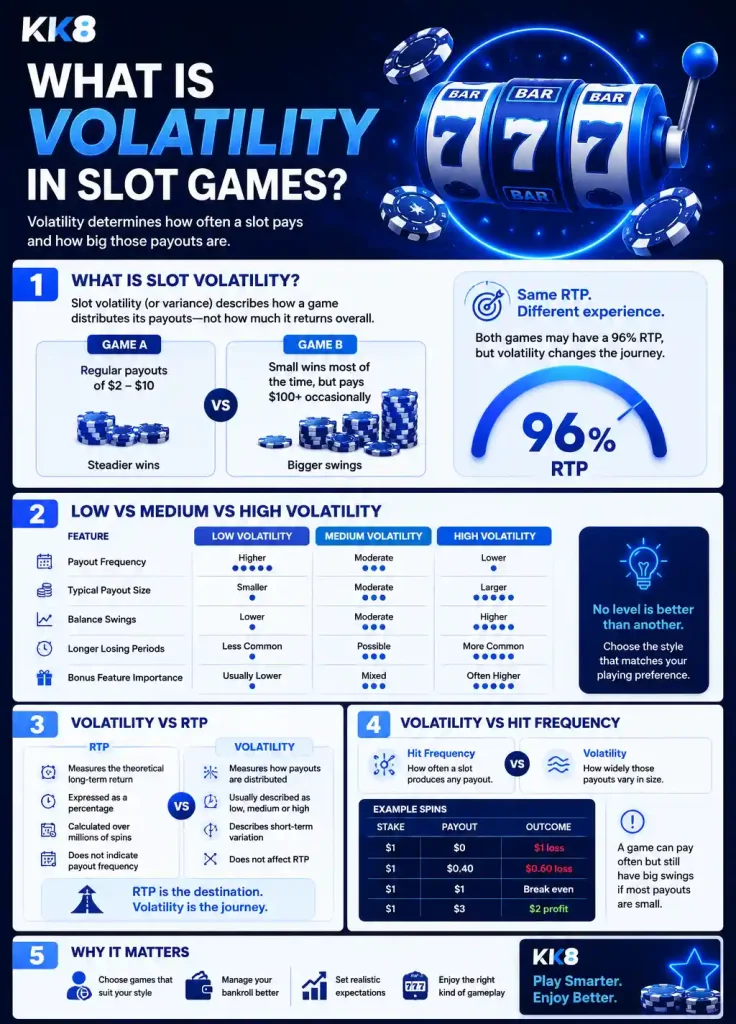
Imagine two fictional slot games with an RTP of 96%.
Game A regularly awards payouts between $2 and $10.
Game B pays very little during most spins but occasionally awards $100 or more.
Although both games have the same theoretical RTP, the playing experience feels completely different. Game A offers steadier results, while Game B creates larger swings in your balance. This is why volatility is one of the most useful statistics to understand alongside RTP.
Why Volatility Matters
Understanding volatility helps you compare games more accurately instead of relying only on headline RTP figures. Volatility shapes your experience every time you play. It influences:
- How often winning combinations appear.
- The typical size of payouts.
- How quickly your balance changes.
- How common longer losing sequences are.
- Whether a large portion of a game’s payout potential sits inside bonus features.
Many new players mistakenly assume that a higher-volatility game offers better odds of winning. In reality, volatility doesn’t change a game’s theoretical return. It simply changes how that return is distributed.
Low vs Medium vs High Volatility
Most slot games are broadly classified into three categories.
| Feature | Low Volatility | Medium Volatility | High Volatility |
| Payout frequency | Higher | Moderate | Lower |
| Typical payout size | Smaller | Moderate | Larger |
| Balance swings | Lower | Moderate | Higher |
| Longer losing periods | Less common | Possible | More common |
| Bonus feature importance | Usually lower | Mixed | Often higher |
No volatility level is objectively better than another. Each creates a different style of gameplay. Some players enjoy regular smaller wins, while others prefer games that reserve much of their payout potential for less frequent but larger prizes.
Slot Volatility vs RTP
Volatility and RTP are often confused because both describe aspects of a slot game’s mathematics. In reality, they measure completely different things.
| RTP | Volatility |
| Measures the theoretical long-term return | Measures how payouts are distributed |
| Expressed as a percentage | Usually described as low, medium or high |
| Calculated over millions of spins | Describes short-term variation |
| Does not indicate payout frequency | Does not affect RTP |
Think of RTP as the destination and volatility as the journey. Two games might both have an RTP of 96%, but one could provide regular small payouts while the other produces longer dry spells followed by occasional larger wins. Neither game is mathematically better simply because it has a different volatility level.
Volatility vs Hit Frequency
Another concept that is frequently confused with volatility is hit frequency.
Hit frequency measures how often a slot produces any payout. Volatility measures how widely those payouts vary in size. These are related, but they are not the same thing.
A game could award payouts on 30% of spins while still feeling highly volatile if many of those payouts are smaller than the original stake and most of the game’s RTP is concentrated in rare bonus features.
For example:
| Stake | Payout | Outcome |
| $1 | $0 | $1 loss |
| $1 | $0.40 | $0.60 loss |
| $1 | $1 | Break even |
| $1 | $3 | $2 profit |
Although three of these examples technically produce a payout, only one generates a net profit. This explains why a game with a relatively high hit frequency can still produce noticeable balance swings.
How Slot Volatility Works

Every slot game is built around a mathematical model that determines how prizes are distributed across thousands, or even millions, of possible outcomes.
This model controls factors such as:
- Symbol combinations.
- Bonus feature frequency.
- Prize sizes.
- Jackpot probability.
- Overall RTP.
Lower-volatility games usually spread their theoretical return across more frequent, smaller payouts. Higher-volatility games often concentrate a greater share of their RTP in larger prizes that occur less frequently.
Many modern slots also allocate a significant portion of their payout potential to free spins, multiplier features or bonus rounds. As a result, players may experience long stretches of smaller payouts before triggering a feature that accounts for much of the game’s overall return.
To better understand the mathematics behind slot games, read our guide on How Online Slot Games Work.
Why Two Slots With the Same RTP Feel Different
Consider these fictional examples. Both games have a theoretical RTP of 96%.
Game A
- Frequent $2 to $8 payouts
- Bonus rounds trigger regularly
- Few very large wins
Game B
- Longer periods without meaningful payouts
- Larger bonus prizes
- Rare high-value wins
Over thousands of spins, both games might return the same theoretical percentage. Over 100 spins, the results could look completely different. This illustrates why RTP and volatility should always be considered together.
How Slot Providers Measure Volatility
There is no universal industry standard for measuring slot volatility.
Different software providers use their own internal mathematical models and rating systems. Some simply classify games as low, medium or high volatility, while others use star ratings or numerical scales.
Because these systems aren’t standardised, a four-star volatility rating from one provider isn’t necessarily equivalent to a four-star rating from another.
When researching a slot game, it’s helpful to consider several pieces of information together instead of relying on a single rating.
These include:
- RTP
- Volatility rating
- Maximum advertised win
- Bonus feature design
- Independent game reviews
Using multiple sources gives you a more complete picture of how a slot is designed to behave.
How to Identify a Slot's Volatility
Although volatility isn’t always displayed in the game lobby, there are several ways to estimate a slot’s characteristics before playing.
Checklist:
- Review the game’s information screen.
- Check the provider’s website.
- Look for the published RTP.
- See whether the volatility rating is available.
- Read the paytable.
- Review how bonus features work.
- Compare independent reviews.
- Try demo mode if available.
Avoid estimating volatility after only a few spins. Short sessions rarely reflect a game’s long-term design.
If you’d like to compare games with different mechanics and volatility levels, explore our guide to Popular Online Slot Games Singapore.
What Volatility Cannot Tell You

Volatility helps explain how payouts are distributed. It does not tell you:
- Whether your next spin will win
- When a bonus feature will trigger
- How long a losing sequence will last
- Whether a jackpot will be awarded
- Whether one session will end in profit
- Whether a game is fair or licensed
Understanding these limitations helps set realistic expectations and avoids common misconceptions.
Choosing the Right Volatility
There isn’t a universal “best” option. Different players prefer different experiences.
| Preference | Often Associated With |
| Frequent smaller payouts | Lower volatility |
| Balance between frequency and prize size | Medium volatility |
| Larger but less frequent prizes | Higher volatility |
Understanding your own expectations is more useful than chasing a specific volatility label.
Key Takeaways
Slot volatility is one of the most important concepts for understanding how slot games behave. While RTP explains a game’s theoretical long-term return, volatility describes how those returns are distributed across individual spins.
Remember these key points:
- Volatility affects payout frequency and prize size.
- RTP and volatility measure different aspects of a slot game.
- Two games with the same RTP can feel completely different.
- Hit frequency and volatility are related but not the same.
- High volatility doesn’t increase your chances of winning.
- Provider volatility ratings aren’t standardised across the industry.
Understanding volatility alongside RTP, hit frequency and bonus features gives you a more complete picture of how different slot games are designed.
Frequently Asked Questions
What does slot volatility mean?
Slot volatility describes how frequently a game awards payouts and how large those payouts typically are. It explains the pattern of wins rather than the theoretical return.
Is high volatility better than low volatility?
Neither is inherently better. High-volatility games generally produce larger balance swings, while lower-volatility games tend to award smaller payouts more frequently.
Can two slot games have the same RTP but different volatility?
Yes. RTP measures the theoretical long-term return, while volatility describes how those returns are distributed across individual spins.
Does volatility affect my chances of winning?
Volatility affects the pattern of payouts, not the theoretical return of the game. It does not increase or decrease the probability of the next spin producing a particular outcome.
How do I know if a slot is high volatility?
Check the game’s information screen, provider website or published game documentation. Many developers classify their titles as low, medium or high volatility, although there is no universal rating system.
Is volatility the same as variance?
The terms are often used interchangeably in the casino industry. Technically, variance is the mathematical measurement, while volatility is the more commonly used consumer-facing description.
Can slot volatility change?
No. Volatility is built into the mathematical design of a game and remains consistent unless the game itself is redesigned.