Skip to content
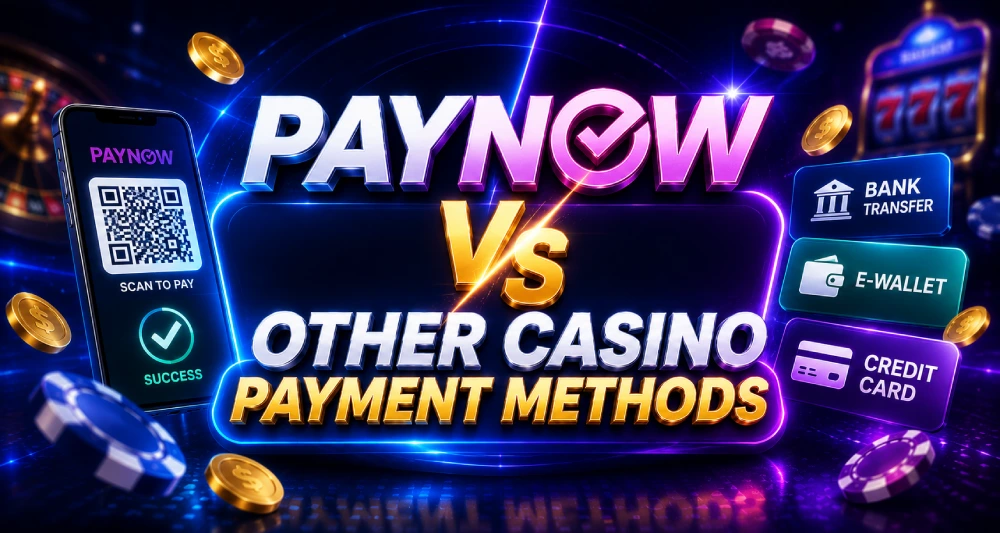
Online gambling platforms can support different payment methods, including PayNow, bank transfers, e-wallets and cards. Each works differently in terms of transaction speed, convenience, verification and withdrawal support.
For Singapore users comparing online gambling payment options, PayNow is particularly relevant because it supports instant SGD transfers through Singapore’s FAST payment infrastructure. However, the fastest or most convenient method will depend on the platform and transaction type.
For a broader explanation of online gambling, payments and how platforms operate, read our Online Gambling Singapore Guide.
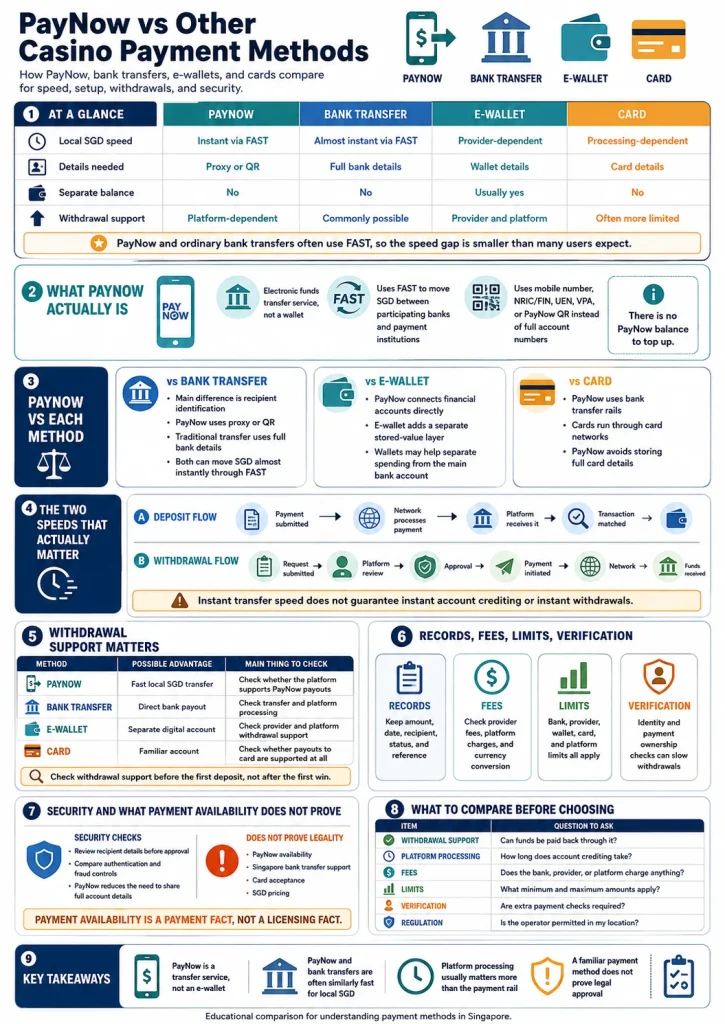
At a Glance
| Factor | PayNow | Bank Transfer | E-Wallet | Card |
|---|---|---|---|---|
| Local SGD speed | Instant via FAST | Almost instant via FAST | Provider-dependent | Processing-dependent |
| Details needed | Proxy or QR | Full bank details | Wallet details | Card details |
| Separate balance | No | No | Usually yes | No |
| Withdrawal support | Platform-dependent | Commonly possible | Provider and platform | Often more limited |
Note the second row carefully. PayNow runs on FAST, and ordinary bank transfers can use FAST too, so the speed gap between them is often smaller than people assume.
What PayNow Actually Is
PayNow is an electronic funds transfer service, not a wallet. It lets customers of participating banks and major payment institutions send and receive SGD through FAST using registered identifiers instead of account numbers.
Supported identifiers include mobile number, NRIC/FIN, UEN for businesses, Virtual Payment Address, and PayNow QR.
The distinction matters because PayNow is built on Singapore’s existing FAST infrastructure rather than operating as a stored-value account. There is no PayNow balance to top up.
For the basic payment process, read How PayNow Transfers Work in Singapore.
PayNow vs Bank Transfer
Both move money directly between financial accounts. The real difference is how the recipient is identified, not how fast the money travels.
PayNow uses a mobile number, NRIC/FIN, UEN, VPA or QR code, while a traditional transfer needs the bank name, account number and recipient details. When both run on FAST, SGD moves almost instantly either way.
So the honest comparison is “banking details versus an identifier”, not “slow versus instant”. PayNow’s advantage is fewer fields and less room for a typo, which matters most on a phone. It does not remove the need to check the recipient, and a mistyped proxy sends money just as irreversibly as a mistyped account number.
For a more detailed comparison, read PayNow vs Bank Transfer for Online Casinos.
PayNow vs E-Wallet
Both are digital, but structurally different.
PayNow connects participating financial accounts through FAST. An e-wallet adds another account layer between you and the merchant, holding stored value, linking to a bank account or card, and keeping its own balance. Some payment institutions participate in PayNow, so it can connect eligible e-wallet accounts too.
Neither is automatically better. PayNow suits users wanting direct bank-based transfers without another balance to manage. An e-wallet suits users wanting payment activity separated from their main bank account.
One practical difference: an extra wallet layer means an extra place funds can sit, and an extra provider whose withdrawal support the platform must also accept.
For the dedicated comparison, read PayNow vs E-Wallet for Casino Deposits.
PayNow vs Credit Card
These use entirely different systems. PayNow transfers SGD through participating financial institutions on FAST, while a card transaction runs through the card network and issuing institution.
PayNow: Select payment > Open banking app > Review recipient > Approve transfer Card: Enter or select card > Payment authorised > Transaction processed
The information requirement is the meaningful distinction. PayNow works from a QR code or proxy, while cards require details to be entered or stored. For anyone reluctant to leave card details with a platform, that matters, and it limits what is exposed if the platform is later compromised.
For the dedicated comparison, read PayNow vs Credit Card for Online Gambling.
The Two Speeds That Actually Matter
Payment network speed is how fast money moves through the financial system. PayNow is instant through FAST, and FAST transfers move SGD almost instantly between participating institutions.
Platform processing speed is how fast the platform finds the transaction, matches it to your account, credits the deposit, reviews a withdrawal and sends a payout.
A deposit runs through both:
Payment submitted > Network processes payment > Platform receives it > Transaction matched > Balance updated
This is why a banking app can show “transfer successful” while the platform still shows “deposit processing”. No payment rail can speed up the second stage.
Withdrawals invert the problem:
Request submitted > Platform review > Approval > Payment initiated > Network > Funds received
The platform controls four steps before the payment method is involved at all. A withdrawal under review for hours has not reached PayNow yet, so a faster rail changes nothing about that wait.
Read Which Payment Method Is Fastest for Singapore Players? for a deeper comparison.
Withdrawal Support Is the Underrated Factor
| Method | Possible Advantage | Main Thing to Check |
|---|---|---|
| PayNow | Fast local SGD transfer | Whether the platform supports PayNow payouts |
| Bank transfer | Direct bank payout | Transfer and platform processing |
| E-wallet | Separate digital account | Provider and platform withdrawal support |
| Card | Familiar account | Whether payouts to card are supported at all |
Most people choose a method by looking at deposits, then discover the platform pays out differently. A platform might accept one method for deposits and use another entirely for withdrawals, with card payouts the most commonly restricted. Check withdrawal support before the first deposit, not after the first win.
Transaction Records and Missing Deposits
PayNow and bank transfers appear in banking transaction histories, e-wallet payments in the wallet’s own records, and card payments in card statements. A clear record gives the amount, date, recipient, status and reference, which is what support needs when a platform says a payment has not arrived.
The practical rule: if your banking side shows success but the gaming balance has not updated, check the platform’s deposit status before sending anything again. A second transfer to fix a matching problem creates two payments to reconcile instead of one.
Fees, Limits and Verification
Three fee sources are worth checking, since users often check only one: the payment provider’s fees, the platform’s deposit or withdrawal charges, and currency conversion where source and receiving currencies differ. Local SGD PayNow transfers avoid the conversion issue entirely.
Limits come from as many directions: bank settings, provider rules, card limits, wallet limits, and the platform’s own caps. A method can be instant and still unsuitable above your allowed limit, and PayNow remains subject to your bank’s daily local transfer limits.
Verification can undo any speed advantage. A platform may need to confirm the account holder name, payment ownership, bank details or identity. A payment can transfer successfully while account-level verification remains incomplete, which matters most at withdrawal, where ownership checks often precede release.
For troubleshooting, read Payment Verification Issues Explained.
Security and What Payment Availability Does Not Prove
Compare security processes rather than declaring one method safest. Authentication, recipient verification, device security and fraud controls all matter, on the payment side and the platform side alike.
PayNow’s design means you never need the recipient’s full account number, which limits what information moves around. It does not protect against sending funds to the wrong recipient, so reviewing details before approval remains the step that matters.
For payment safety, read Is PayNow Safe for Online Casino Transactions?
Separately, and this is the point most worth taking away: a familiar payment method proves nothing about an operator. PayNow availability, Singapore bank transfers, card acceptance and SGD pricing are payment facts, not licensing facts.
GRA states that gambling is prohibited unless licensed or exempted, and that unlicensed remote gambling supplied from overseas to people in Singapore is unlawful. Payment verification and operator verification are separate checks.
For more detail, read How to Verify an Online Casino.
What to Compare Before Choosing
| Check | Question to Ask |
|---|---|
| Withdrawal support | Can funds be paid back through it? |
| Platform processing | How long does account crediting take? |
| Fees | Does the bank, provider or platform charge anything? |
| Limits | What minimum and maximum amounts apply? |
| Verification | Are extra payment checks required? |
| Regulation | Is the gambling operator permitted in my location? |
Transfer speed is deliberately absent, because for local SGD it is rarely the constraint. Platform processing, withdrawal support and limits decide the actual experience far more often than the rail does.
There is no universal best casino payment method Singapore users should pick. PayNow suits direct SGD transfers with no separate balance to manage, bank transfers suit those preferring traditional account details, e-wallets suit users wanting separation from their main bank flow, and cards suit those wanting one familiar method across services. The choice still depends on what the operator supports in both directions.
Common Misconceptions
"PayNow is faster than every bank transfer."
Not necessarily. PayNow runs on FAST, and ordinary FAST transfers move SGD between participating institutions almost instantly too.
"PayNow is an e-wallet."
No. It is an instant funds-transfer service connecting participating banks and payment institutions through FAST, with no separate balance.
"PayNow guarantees an instant casino deposit."
No. The transfer can complete instantly while the platform still needs to identify and credit it.
"The same method must be used for withdrawals."
Not always. Deposit and withdrawal options follow the platform’s own payment rules.
"A casino accepting PayNow must be legal in Singapore."
Incorrect. Payment availability does not determine gambling licensing.
Frequently Asked Questions
Is PayNow better than other casino payment methods?
It is convenient for Singapore users because it supports instant SGD transfers through FAST. Whether it is better depends on platform support, withdrawal availability, limits and fees.
What is the difference between PayNow and bank transfer?
PayNow uses FAST but identifies recipients through a mobile number, NRIC/FIN, UEN or VPA, while a traditional transfer uses full account details. Both move SGD almost instantly.
Is PayNow better than an e-wallet for casino deposits?
PayNow transfers directly between participating financial accounts, while an e-wallet adds a separate account layer. Which suits you depends on your setup and what the platform supports.
Is PayNow faster than a credit card?
PayNow is instant through FAST, while cards run on a different network. Final deposit speed still depends on the receiving platform either way.
Does accepting PayNow mean an online casino is legal in Singapore?
No. GRA states that Singapore Pools is the only operator licensed by GRA to provide remote gambling services in Singapore.