Skip to content
Gambling regulations in Singapore use a controlled licensing system rather than treating every activity the same way. The Gambling Regulatory Authority of Singapore (GRA) oversees the framework under the Gambling Regulatory Authority Act 2022, the Gambling Control Act 2022 and the Casino Control Act 2006.
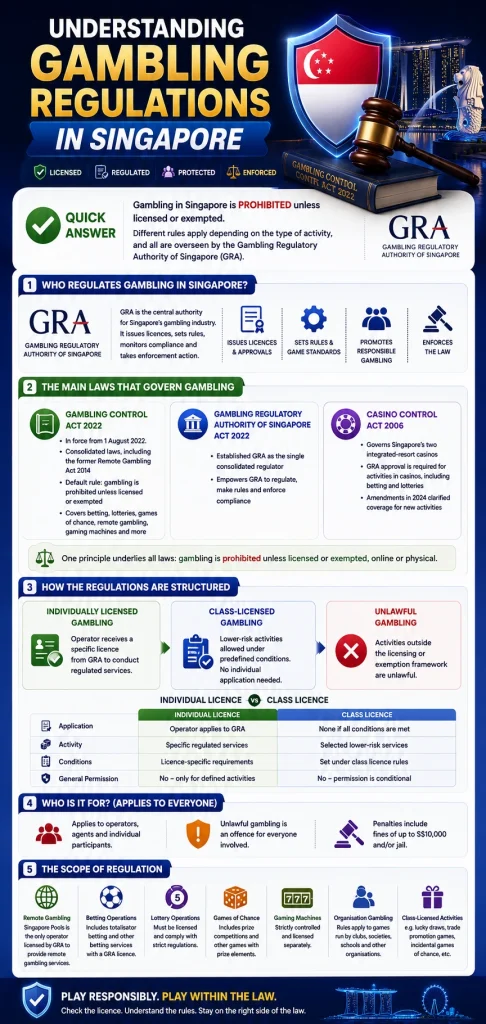
The main principle is simple: gambling is prohibited unless licensed or exempted, online or physical. Different rules then apply depending on whether the activity involves casinos, betting, lotteries, remote gambling, gaming machines, or lower-risk activities under class licences.
Worth separating early: laws and regulations are not the same thing. Laws are the Acts passed by Parliament, regulations are the detailed requirements GRA makes within that framework, and licence conditions apply directly to individual operators. A service can be legal in principle and still breach its license conditions.
For a broader overview of the legal framework itself, read Singapore Gambling Laws Explained.
Quick Answer
Singapore’s gambling regulations rest on four things: licensing, approval, enforcement, and harm-minimisation controls. The Gambling Control Act 2022 provides most of the framework for betting, lotteries, games of chance and remote gambling outside the casino regime.
Lower-risk activities such as qualifying lucky draws may operate under class licences when all conditions are met. Remote gambling is far more restricted, and GRA states that Singapore Pools is the only operator licensed to provide remote gambling services here.
Who Regulates Gambling in Singapore?
GRA is the central authority for Singapore’s gambling industry, consolidating what was previously a fragmented arrangement across multiple bodies, and it can also make regulations for the industry.
Regulation involves far more than issuing licences. GRA handles approvals, operator compliance, game rules, social safeguards and enforcement, all continuing for as long as an operator holds a licence.
For readers starting with the broader topic, see the Online Gambling Singapore Guide.
What Does the Gambling Control Act Cover?
The Gambling Control Act 2022 came into effect on 1 August 2022, consolidating earlier legislation including the former Remote Gambling Act 2014.
Its default rule is that gambling is prohibited unless licensed or exempted, and the government stated during its passage that unlawful gambling offences apply to everyone involved, including operators, agents and individual participants.
The Act covers betting operations, lotteries, games of chance, remote gambling, gaming machine operations, gambling by organisations, and class-licensed activities. Requirements differ by service, which is why “how is this specific activity regulated” is the more useful question.
How the Regulations Are Structured
| Regulatory Category | How It Works |
|---|---|
| Individually licensed gambling | Operator receives a specific licence from GRA |
| Class-licensed gambling | Proceeds under predefined conditions, no individual application |
| Unlawful gambling | Falls outside the permitted framework |
Betting and lottery services generally need a GRA license, while qualifying lower-risk activities such as certain lucky draws may fall under a class license instead.
Individual Licences
GRA states that anyone wishing to conduct betting operations, including totalisator betting, or lottery operations must be licensed. The licence may cover accepting or settling bets, facilitating betting arrangements, games of chance involving prizes, and lotteries.
Approval extends to the details. Under Section 69 of the Gambling Control Act, a licensee must obtain GRA approval for the contents of the rules governing its licensed betting, games of chance and lotteries. Permission covers defined activities, not authority to offer every gambling product.
Class Licences
Class licences cover selected lower-risk services: qualifying lucky draws, trade promotion games and lotteries, incidental games of chance, and certain remote games of chance. An organisation covered by one does not need to submit an individual application, provided all conditions are met.
| Area | Individual Licence | Class Licence |
|---|---|---|
| Application | Operator applies to GRA | None if all conditions are met |
| Activity | Specific regulated service | Selected lower-risk services |
| Conditions | Licence-specific | Set under class licence rules |
| General permission | No | No |
Note the last row. Neither route grants general permission, and a class licence is never an exemption covering online casinos, sportsbooks or unrelated services.
How Is Remote Gambling Regulated?
Remote gambling is the most tightly controlled part of the framework. GRA states that it is unlawful to provide unlicensed remote gambling services in Singapore, from Singapore, or from outside Singapore to persons situated in Singapore. Singapore Pools is the only operator currently licensed to provide them.
The delivery method changes the regulatory problems without changing the principle. Physical regulation focuses on venues, entry controls and equipment. Remote regulation adds online access, overseas operators, website blocking, digital advertising, remote payments and account-based controls.
An overseas operator does not escape these rules because its company, servers or facilities sit elsewhere. GRA states the definition covers facilities located outside Singapore, partly or fully, and none of the following establishes approval: overseas registration, a foreign licence, acceptance of Singapore users, SGD support, PayNow availability, or the site being reachable.
Payment method is the most persuasive false signal of the lot. A platform accepting PayNow, cards or local bank transfers has established nothing about its licensing.
For a dedicated explanation, read Remote Gambling in Singapore Explained.
Advertising and Enforcement
Promotion is regulated separately from accepting bets. GRA states that advertising unlawful gambling in Singapore, from Singapore, or from outside Singapore into Singapore is an offence. An advertisement on a website or social platform is therefore not evidence the service is lawful.
GRA acknowledges that operators based outside Singapore present practical enforcement difficulties, which is why website blocking is used against unlawful services reachable by Singapore users.
Participation carries real exposure. GRA confirms that taking part in unlicensed remote gambling is an offence for a person in Singapore, with a maximum penalty of a fine up to SGD10,000, imprisonment up to six months, or both.
PayNow often appeals to users who already rely on Singapore mobile banking and prefer direct account-to-account payments.
For a broader payment comparison, read Which Payment Method Is Fastest for Singapore Players?
How Are Licensed Operators Monitored After Approval?
Licensed operators must keep complying with licence conditions, and GRA publishes enforcement actions against operators and approved venues. In May 2026, GRA listed a SGD100,000 financial penalty against Singapore Pools for failing to verify customers’ exclusion status.
That example is instructive because it involves the licensed operator rather than an illegal site. Regulation is a continuing obligation, not a one-time approval, and it covers harm-minimisation duties as much as commercial ones.
Social Safeguards and Self-Exclusion
Harm reduction is built into the framework rather than sitting alongside it. The National Council on Problem Gambling (NCPG) manages exclusion and visit-limit programmes, with individual self-exclusion covering Marina Bay Sands, Resorts World Sentosa, jackpot machine rooms at private clubs, and Singapore Pools online betting.
Anyone applying must remain excluded for at least one year before applying for revocation. That minimum is deliberate, making exclusion a durable barrier rather than something reversible on impulse.
These protections exist because the activity is regulated, and no equivalent applies on an unlicensed offshore site.
For a dedicated guide, read Responsible Gambling Singapore.
Casinos, Gaming Machines and Community Gambling
Casino gambling has its own structure under the Casino Control Act 2006, with GRA regulating operators, activities, equipment and approvals. Technical compliance reaches down to the hardware: GRA-approved laboratories testing casino gaming equipment must maintain ISO/IEC 17025 accreditation.
Gaming machine rooms fall under the Gambling Control Act, with GRA licensing eligible operators against suitability criteria. Approved venues remain subject to conditions, and GRA’s enforcement records include action against venues that failed to conduct required social safeguard checks.
Community gambling is also covered. GRA licenses eligible community organisations conducting gambling for social purposes at approved venues. A private or social setting does not automatically sit outside regulation. What matters is whether the activity meets the definition of gambling and whether a permitted framework applies.
Across all of these, Singapore uses different regulatory tools depending on the activity rather than one identical rule for every product.
Common Misunderstandings
"All gambling is illegal in Singapore."
Incorrect. The framework permits gambling that is licensed or exempted.
"An overseas gambling licence is enough."
Incorrect. The rules apply to unlicensed services provided from overseas to people located in Singapore.
"All legal gambling uses the same licence."
Incorrect. Singapore uses individual licences, casino-specific regulation and class licences depending on the activity.
"If a gambling website is accessible, it is approved."
Incorrect. Accessibility establishes nothing. GRA uses website blocking as one enforcement measure, so a reachable site may simply not have been blocked yet.
"Regulation ends once an operator gets a licence."
Incorrect. GRA monitors compliance and publishes enforcement actions against licensed entities that breach requirements.
Regulation Checklist for Singapore Users
| Check | Question to Ask |
|---|---|
| Operator | Who is the legal entity behind the brand? |
| Activity | What type of gambling is involved? |
| GRA status | Does the operator hold the required approval? |
| Remote access | Is the activity conducted online? |
| Overseas operation | Is an overseas operator serving Singapore users? |
| Class licence | Does a qualifying class licence apply? |
| Advertising | Is unlawful gambling being promoted? |
| Compliance | Is the operator subject to current regulatory action? |
Start with GRA’s own information rather than the operator’s website, and identify the legal entity first, since a brand name and the company behind it are frequently different. Check current enforcement records too, not just whether a licence exists.
For website-level checks, read How to Verify an Online Casino.
Frequently Asked Questions
Who regulates gambling in Singapore?
The Gambling Regulatory Authority of Singapore, exercising powers under the Gambling Regulatory Authority Act 2022, the Gambling Control Act 2022 and the Casino Control Act 2006.
What is the main gambling regulation in Singapore?
The Gambling Control Act 2022, which came into effect on 1 August 2022 and covers gambling outside the casino-specific regime.
Does every gambling activity require an individual licence?
No. Certain lower-risk activities operate under class licences when all prescribed conditions are met.
How is online gambling regulated in Singapore?
Within the remote gambling framework. GRA states that Singapore Pools is the only operator licensed to provide remote gambling services, and both providing and participating in unlicensed remote gambling are offences.
Are licensed operators still monitored after approval?
Yes. They remain subject to license conditions and regulatory requirements, and GRA publishes enforcement actions when operators or approved venues breach those obligations.