Skip to content

The future of casino payment methods is moving toward faster settlement, fewer payment steps, stronger verification, and better connections between domestic and cross-border payment networks. In Singapore, PayNow already provides instant SGD transfers through FAST, while newer initiatives are looking at how instant payments could become easier to use for online checkout and international transfers.
For online gaming payments, the important change is not simply whether a transaction is labelled “instant.” The wider payment process includes selecting a method, confirming recipient information, authenticating the transaction, processing the payment, matching it to an account, and handling withdrawals. Future casino payments are therefore likely to focus on reducing friction across the entire process rather than only increasing transfer speed.
For a broader explanation of PayNow payments used by Singapore players, read our PayNow Casino Singapore guide.
Quick Answer
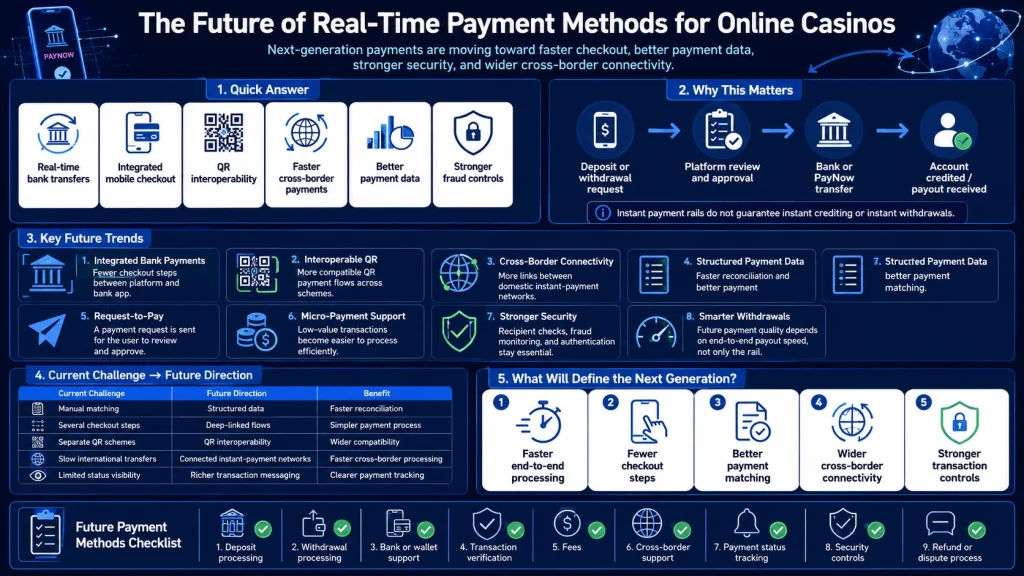
The future of online casino payments is likely to centre on real-time bank transfers, integrated mobile checkout, QR interoperability, faster cross-border payments, better payment data, and stronger fraud controls. Singapore is already moving in this direction. PayNow supports instant transfers through FAST, while the PayNow Generation 2 study announced in June 2026 is examining upgrades such as improved QR interoperability, smoother online checkout, request-to-pay, structured payment data, micro-payment infrastructure, expanded cross-border connections, offline payment capabilities, and support for new automated commerce use cases.
These developments do not mean every online gaming platform will adopt every feature. They show where Singapore’s broader instant-payment infrastructure is heading, and they provide useful signals for the next generation of casino payments.
Why Real-Time Payments Matter for Online Casinos
Payment speed affects both deposits and withdrawals, but speed alone does not determine the overall experience. A deposit might move through the banking network instantly while the receiving platform still needs to identify and credit it. A withdrawal might require platform review before any bank transfer begins.
This distinction is already visible with PayNow. The Association of Banks in Singapore describes PayNow as an instant SGD transfer service operating through FAST, 24 hours a day and 365 days a year.
Future casino payment technology will therefore need to address several stages together: payment initiation,How PayNow Transfers Work in Singapore? authentication, transaction matching, account crediting, payout approval, and status tracking.
1. Real-Time Bank Payments Will Become More Integrated
One of the clearest payment trends is deeper integration between merchants, apps, banks, and instant-payment networks.
Today, a PayNow user might scan a QR code, switch to a banking app, verify the recipient, enter or confirm an amount, and approve the transfer. Future systems aim to reduce some of these steps.
The PayNow Generation 2 study announced by MAS and the Association of Banks in Singapore includes work on deep-linking within PayNow QR codes for online checkout. The stated goal is to reduce the number of payment steps and create a smoother checkout process for online merchants.
For digital casino payment methods, similar payment flows would mean fewer manual steps between selecting PayNow and completing a transaction.
What This Could Mean for Players
A more integrated payment journey might involve selecting PayNow on a payment page, moving directly into the relevant banking flow, reviewing the transaction, and returning to the platform after approval.
This would reduce reliance on manually copying payment information or switching between several screens. It would also make correct recipient verification more important because faster checkout should not remove transaction checks.
2. QR Payments Will Become More Interoperable
QR codes are already part of Singapore’s payment system. PayNow QR is integrated with SGQR, allowing users to make payments through participating banking and payment apps.
The next stage is broader interoperability.
In June 2026, MAS and ABS said they were exploring improvements between QR PayNow and NETS QR so consumers could scan and pay merchants regardless of which of the two schemes a merchant uses. A pilot was targeted for the end of 2026.
This matters for the future of casino payment methods because payment systems become easier to integrate when merchants and users rely on compatible standards rather than separate closed payment flows.
3. Cross-Border Real-Time Payments Will Expand
Singapore has already connected PayNow with instant-payment systems in other countries. Current linkages include PromptPay in Thailand, UPI in India, and DuitNow in Malaysia. These systems support fast or near-real-time cross-border transfers through participating financial institutions.
The wider direction is moving beyond individual country-to-country connections.
Project Nexus was developed by the BIS Innovation Hub to connect domestic instant-payment systems through a standardised multilateral model. BIS says participating countries incorporated Nexus Global Payments in 2025 to move the project toward live implementation. The model aims to allow participating payment systems to connect once and reach other systems within the network.
Why Cross-Border Connectivity Matters
Many online platforms operate across several markets. A payment system that connects domestic instant-payment networks more efficiently could reduce reliance on slower international transfer processes.
This does not mean Singapore users will automatically gain access to every overseas payment recipient. Financial institutions, platform policies, regulatory rules, supported corridors, currency conversion, and transaction screening will still affect availability.
The broader direction is clear: next generation casino payments will increasingly operate within payment networks designed for faster cross-border connectivity.
4. Payment Data Will Become More Useful
Payment speed solves only part of the problem. Businesses also need to know who sent the payment, what transaction it relates to, and how it should be recorded.
The PayNow Generation 2 study lists structured data fields for automated reconciliation among the longer-term capabilities being explored.
This is particularly relevant to online payments. A platform might receive money instantly but still experience a delay if it cannot match the transfer to the correct user or order.
Better transaction data could improve this process.
| Current Payment Challenge | Future Payment Direction | Possible Benefit |
|---|---|---|
| Manual payment matching | Structured payment data | Faster account reconciliation |
| Several checkout steps | Deep-linked payment flows | Simpler payment process |
| Separate QR schemes | Greater QR interoperability | Wider payment compatibility |
| Slow international transfers | Connected instant-payment networks | Faster cross-border processing |
| Limited payment status information | Richer transaction messaging | Clearer payment tracking |
| Manual payment requests | Request-to-pay | More structured payment initiation |
5. Request-to-Pay Could Change How Payments Start
Traditional payments usually begin with the customer manually entering or selecting payment information.
Request-to-pay changes the process. Instead of asking the customer to manually create the transaction, a merchant or service sends a structured payment request that the customer reviews and approves.
Request-to-pay is among the longer-term capabilities included in the PayNow Generation 2 study.
For future casino payments, a similar model could reduce errors associated with entering amounts, references, or recipient information manually. The customer would still need to review and approve the request through the relevant payment service.
6. Micro-Payments Could Receive More Attention
MAS and ABS are also examining a micro-payments rail as part of longer-term PayNow development.
Micro-payment infrastructure is designed to process low-value transactions efficiently. While this work is not specific to online casinos, it shows how payment infrastructure is becoming more specialised for different transaction types.
For online platforms more broadly, efficient low-value processing might create new payment models where traditional card costs or processing structures are less suitable.
7. Security Will Develop Alongside Payment Speed
Faster payments create a simple challenge: users have less room to correct mistakes after confirming a transaction.
PayNow already includes recipient verification before payment confirmation. ABS states that the sender sees the recipient’s display name before completing the transfer, helping the sender verify where the money is going.
Future payment systems will need to balance speed with authentication, recipient verification, fraud controls, transaction monitoring, and dispute handling. The PayNow Generation 2 study also identifies fraud prevention and dispute resolution among areas for further development.
For players, this means faster payments should not replace basic transaction checks.
Before making a payment, read How to Keep Your PayNow Casino Transactions Secure.
8. Instant Withdrawals Will Depend on More Than Payment Rails
Real-time bank infrastructure does not automatically create instant casino withdrawals.
A withdrawal normally has two broad stages. The platform reviews and approves the payout first. The payment provider or banking network processes the transfer second.
Even if the second stage becomes faster, identity verification, account checks, promotion conditions, transaction reviews, or manual payout approval might still delay the first stage.
This is why the future of casino payment methods should be measured by end-to-end payout time rather than only the technical speed of the payment network.
For current troubleshooting, read Why Is My PayNow Withdrawal Delayed?
Will PayNow Remain Important for Singapore Players?
PayNow is already built into Singapore’s domestic payment infrastructure. It supports participating banks and major payment institutions, operates through FAST, supports QR payments, and connects with several overseas instant-payment systems.
Current PayNow Generation 2 work also indicates that Singapore intends to continue developing its instant-payment infrastructure rather than replacing it with an entirely separate model. MAS and ABS are studying changes across customer experience, business payments, network coverage, and payment-system capabilities.
For this reason, PayNow and related real-time bank payment infrastructure are likely to remain relevant when discussing the future of online casino payments for Singapore users.
What About E-Wallets, Cards and Other Payment Methods?
Real-time bank payments are only one part of future casino payments. E-wallets, cards, bank transfers, and other regulated payment services will continue serving different needs.
Cards offer established international acceptance. E-wallets provide an additional payment account between the user and merchant. Real-time bank payments reduce the need to enter full card or bank account details for individual transfers. Cross-border instant-payment networks aim to improve international transfers.
The future is therefore less likely to involve one payment method replacing every other method. Different payment systems will compete on speed, cost, checkout convenience, security, availability, and withdrawal support.
For a direct comparison, see PayNow vs E-Wallet for Casino Deposits.
What Will Define the Next Generation of Casino Payments?
Five factors are likely to matter most when evaluating future casino payment technology.
Faster End-to-End Processing
Players will increasingly judge payment methods by how long the full deposit or withdrawal takes, not just the underlying bank transfer.
Fewer Checkout Steps
Deep links, QR codes, and integrated payment approval could reduce manual actions between selecting a payment method and completing the transaction. Singapore’s PayNow Generation 2 work already identifies this as a priority area.
Better Payment Matching
Structured transaction information could help merchants identify and reconcile payments with fewer manual checks.
Wider Cross-Border Connectivity
Projects such as Nexus show how domestic instant-payment systems are moving toward multilateral connections rather than relying only on separate bilateral links.
Stronger Transaction Controls
Recipient verification, fraud prevention, authentication, transaction monitoring, and dispute processes will stay important as transfers become faster.
Future Casino Payment Methods Checklist
When comparing new payment methods in the future, do not judge them only by claims such as “instant” or “fast.”
| What to Check | Why It Matters |
|---|---|
| Deposit processing | Shows how quickly funds reach the account |
| Withdrawal processing | Measures practical payout speed |
| Bank or wallet support | Determines availability |
| Transaction verification | Helps prevent incorrect transfers |
| Fees | Affects the real cost of using the method |
| Cross-border support | Matters for international transactions |
| Payment status tracking | Helps identify delays |
| Security controls | Protects account and payment information |
| Refund or dispute process | Matters when a transaction goes wrong |
Frequently Asked Questions
What is the future of casino payment methods?
The main direction is toward faster bank transfers, more integrated checkout, improved QR interoperability, richer payment information, better cross-border connectivity, and stronger security controls. Singapore’s PayNow Generation 2 work provides current examples of several of these developments.
Will casino payments become completely instant?
The banking transfer itself might take place in seconds, but casino deposits and withdrawals involve additional platform processing. Account verification, transaction matching, withdrawal approval, and security reviews can still add time.
Will PayNow become faster in the future?
PayNow already supports instant SGD transfers through FAST. Current development is therefore focused less on making the underlying domestic transfer simply “faster” and more on improving usability, interoperability, checkout, business payment functions, and network coverage.
What is PayNow Generation 2?
PayNow Generation 2 is a study led by MAS and the Association of Banks in Singapore to examine the next stage of Singapore’s instant-payment infrastructure. Areas announced in June 2026 include QR interoperability, improved online checkout, business payment features, network expansion, and several longer-term payment capabilities.
Will cross-border casino payments become faster?
Cross-border instant-payment infrastructure is expanding. PayNow already has links with selected overseas systems, while Project Nexus is designed to connect multiple national instant-payment networks through a standardized model. Whether a specific gaming transaction is supported still depends on participating institutions, payment corridors, platform policies, and applicable requirements.