Skip to content
Digital payments have changed how people move money across online services in Singapore. Mobile banking, PayNow, QR codes, cards and e-wallets have replaced many slower, manual payment steps.
For online gambling transactions, the main change is not limited to speed. Digital payments have also changed what users expect from a platform. People now look for clear payment instructions, visible transaction records, quick account updates and straightforward withdrawal procedures.
These improvements come with trade-offs. Real-time transfers leave less time to correct mistakes. A completed bank transfer does not always mean the receiving platform has credited the user’s account. Payment technology also does not determine whether an online gambling service is lawful.
This guide explains how digital payments changed online gambling in Singapore, why deposits and withdrawals follow different timelines, and what users should check before transferring money.
From Manual Transfers to Mobile Payment
Earlier online payment processes often involved several separate steps. A user might have needed to:
- Log in to online banking.
- Enter a full bank account number.
- Complete the transfer.
- Save a payment receipt.
- Submit the receipt to the receiving platform.
- Wait for someone to match the payment manually.
This method created several points of friction. A missing reference number or unclear screenshot might delay the account update. Manual checking also became slower during busy periods.
Digital payment systems reduced much of this work. Mobile banking placed transfers, transaction histories and payment confirmations inside one app. QR codes reduced manual data entry. Registered payment identifiers made full bank account numbers less important.
The result was a shorter path between deciding to make a payment and completing it.
How PayNow Changed Payment Expectations
PayNow was launched for participating banks in 2017 and later extended to participating major payment institutions. It lets users transfer Singapore dollars through FAST using identifiers such as a mobile number, NRIC or FIN, Virtual Payment Address or business UEN. The service operates around the clock.
PayNow also changed what users expect from an online payment. Transfers became faster, payment steps became simpler, and users started expecting funds to appear with less delay. As a result, payment speed is no longer seen as an extra feature. It has become part of the basic service users expect from an online platform.
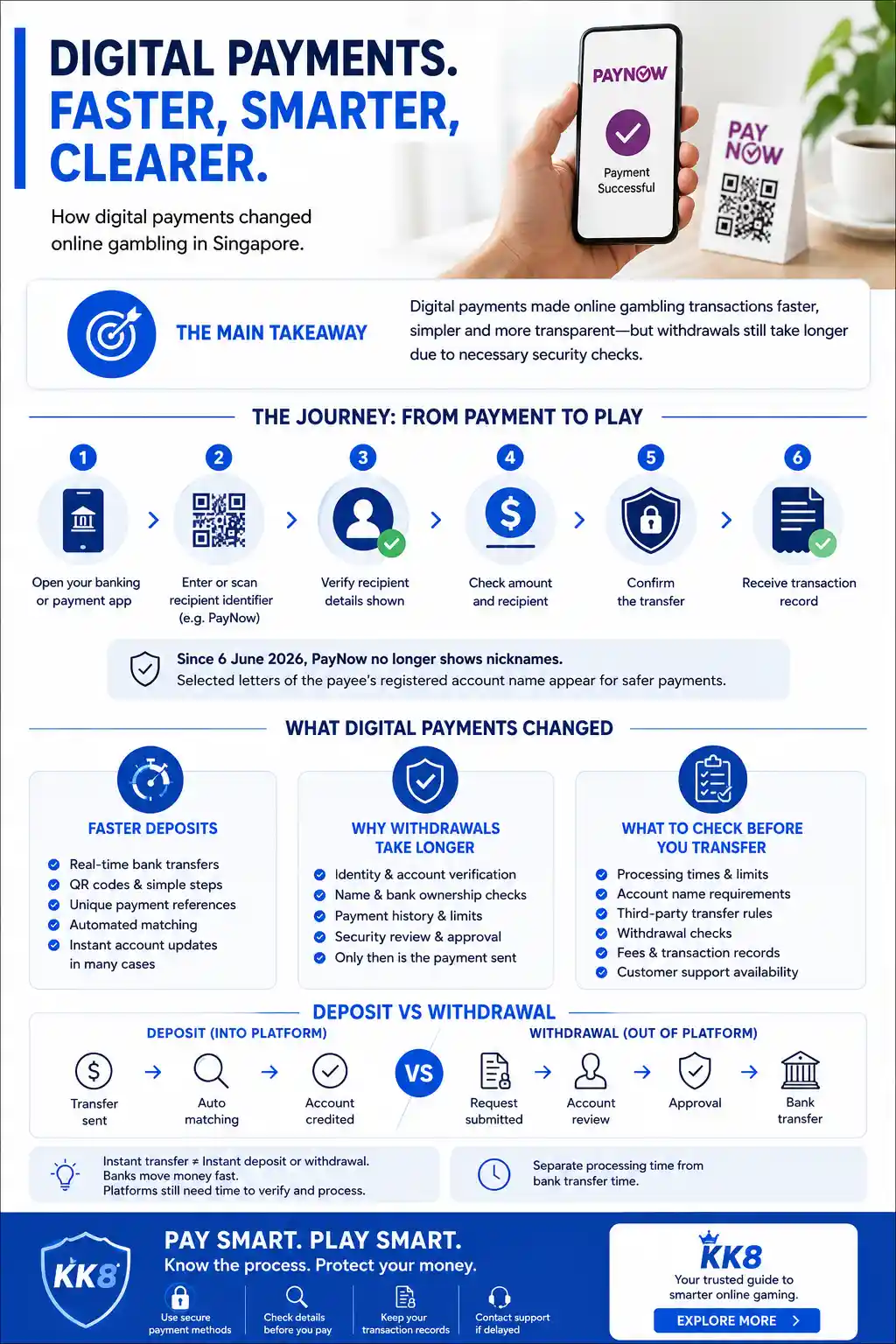
A typical PayNow transaction now looks like this:
- The user opens a banking or supported payment app.
- The user enters or scans the recipient identifier.
- The app displays recipient details.
- The user checks the amount and recipient.
- The transfer is confirmed.
- The app provides a transaction record.
Since 6 June 2026, PayNow has stopped displaying user-selected retail nicknames. Instead, selected letters from the payee’s registered account name appear before payment. The Association of Banks in Singapore introduced the change to reduce impersonation risks while preserving some privacy.
This makes the recipient-checking step more useful, but users still need to confirm the details before authorising payment.
Read: What Is PayNow and How Does It Work for Online Payments?
Why Online Deposits Became Faster
Digital payments shortened the time needed to move money from the sender’s bank account to the recipient. They also supported better payment matching.
For example, a platform might assign a payment reference to a user. When the transfer arrives with the correct amount and reference, an automated system may match it to the relevant account.
This process is faster than asking an employee to compare screenshots against bank records.
Several factors contributed to faster deposits:
- Real-time bank transfers
- QR-based payment instructions
- Unique payment references
- Automated transaction matching
- Digital receipts
- Mobile account notifications
Yet “instant transfer” and “instant deposit” do not always mean the same thing.
A bank might complete the transfer within seconds. The receiving platform might still need to identify the sender, match the payment reference or complete an account check before updating the balance.
Why Withdrawals Often Take Longer Than Deposits
A deposit moves money into a platform. A withdrawal moves money out. These two processes carry different checks.
A platform may process a deposit after confirming the amount, reference and recipient account. A withdrawal often requires additional review before the payment is released.
Common withdrawal checks include:
- Identity verification
- Bank account ownership
- Name matching
- Payment history review
- Withdrawal limits
- Security checks
- Internal approval
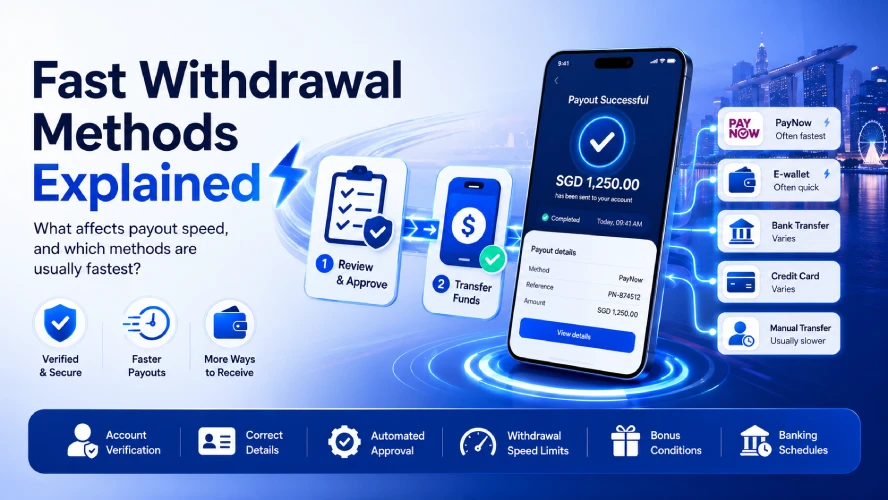
For example, a user might submit a withdrawal request at 2:00pm. Even where PayNow delivers the final transfer quickly, the platform may spend several hours reviewing the request first.
The payment method controls only part of the timeline. A useful way to view the process is:
Withdrawal request → Account review → Approval → Payment instruction → Bank transfer
Users should therefore separate “withdrawal processing time” from “bank transfer time.”
How Digital Payments Changed Platform Evaluation

Payment methods now form part of how users assess an online platform. A list of supported payment logos is not enough. Users also look at the rules surrounding each method.
Important questions include:
- Are processing times explained?
- Are payment limits disclosed?
- Does the account name need to match the bank account?
- Are third-party transfers accepted?
- Are withdrawal checks listed?
- Does the platform issue transaction records?
- Is support available when a transfer is delayed?
- Are fees disclosed before payment?
A platform that accepts a fast payment method may still provide a poor payment experience if its instructions are unclear or its internal processing is slow. This is why users should evaluate the full payment process, not only the transfer technology.
Comparing Common Digital Payment Methods
Different payment methods solve different problems.
| Payment method | How it works | Main strength | Main limitation |
| PayNow | Direct transfer through a bank or supported payment account | Fast local transfers with clear transaction records | Transfers are difficult to reverse after confirmation |
| Bank transfer | Funds move between bank accounts | Familiar process with detailed banking records | Manual entry and payment matching may take longer |
| E-wallet | Funds move through a separate wallet account | Keeps payment activity separate from the main bank account | Funding, fees and withdrawal rules differ by provider |
| Credit or debit card | Payment passes through a card network | Familiar checkout process | Issuer restrictions or authorisation failures may apply |
| QR payment | User scans payment details through a supported app | Reduces manual entry | A false or replaced QR code may direct funds elsewhere |
No payment method is best for every user. Speed matters, but so do recipient verification, transaction records, account protection and dispute procedures.
Faster Payments Created New Risks
Real-time transfers reduce waiting, but they also reduce the time available to notice an error. Once a payment is confirmed, recovering money from the wrong recipient may be difficult.
Common risks include:
- Incorrect recipient details
- False payment instructions
- Replaced QR codes
- Unofficial payment agents
- Missing payment references
- Duplicate transfers
- Payments from third-party accounts
- Phishing pages
- Requests for passwords or one-time codes
Users should check the recipient information shown inside their banking app. They should not rely only on a payment screenshot or message sent through an unfamiliar contact.
The Personal Data Protection Commission advises users to share sensitive information only through official, secure websites and not disclose personal information to unknown parties.
A legitimate payment process should not require a user to provide:
- A bank login password
- A one-time password
- A card security code through chat
- Remote access to a banking device
Digital Records Improved Payment Tracking
One major advantage of digital payments is the transaction trail. A payment record usually includes:
- Date and time
- Amount
- Recipient
- Transaction reference
- Payment status
- Sending account
These records help users determine what happened after a transfer. For example, when a deposit does not appear, the first question should be whether the bank marked the transfer as completed.
If the transfer failed, the user should address the issue with the bank. If the transfer completed but the platform did not update the balance, the user should provide the transaction reference to the receiving platform.
This is more efficient than relying on memory or an incomplete screenshot. Users should avoid making a second transfer before checking the first one. A duplicate payment creates a new transaction and may complicate the investigation.
Digital Payments Did Not Change Singapore’s Gambling Laws

A legal payment method does not make the underlying gambling service legal.
The Gambling Regulatory Authority states that it is unlawful to provide unlicensed remote gambling services to people in Singapore. It is also an offence for a person in Singapore to participate in unlicensed remote gambling. Singapore Pools is the only operator licensed by the GRA to provide remote gambling services in Singapore.
Since 1 January 2025, the Singapore Police Force has handled the blocking of access, advertising and payment transactions connected with unlawful remote gambling services.
This means a user should separate two questions:
- Is the payment method legitimate?
- Is the gambling service lawful in Singapore?
PayNow, a bank transfer or a card payment may be legitimate financial tools. Their use does not confirm the legal status of the recipient service.
This article explains payment systems for educational purposes. It does not confirm the legality of any gambling website or transaction.
What Digital Payments Changed for Users
The largest change is not one payment method. It is the shift in user expectations. Before digital payments became common, people often accepted longer waiting periods and manual confirmation. Today, they expect:
- Mobile-first payment instructions
- Fast transaction confirmation
- Clear status updates
- Searchable payment histories
- Better account matching
- Faster support responses
- More transparent withdrawal rules
These expectations affect how platforms design their payment pages and customer support processes. They also affect how users judge reliability. A long delay without an explanation now stands out more because the banking side of the transaction often moves quickly.
PayNow Education and Media Coverage
As PayNow use has grown, users have also needed clearer information about recipient checks, payment records and transaction delays. KK8 Singapore recently published an educational PayNow guide explaining these issues and outlining practical checks users should complete before transferring funds.
Read the media release: KK8 Singapore launches educational PayNow guide
What Happens When a Payment Goes Wrong
The correct response depends on the payment status.
| Situation | First action |
| Bank shows the transfer as failed | Review the error and contact the bank |
| Bank shows the transfer as pending | Wait for the bank status to update |
| Bank shows completion, but the platform balance is unchanged | Contact the platform with the transaction reference |
| Recipient details are wrong | Contact the bank immediately |
| Payment was made twice | Report both transaction references |
| Bank rejects the transfer | Check transfer limits, account details and bank instructions |
Users should keep the original payment confirmation and avoid editing screenshots. Complete records help the bank or receiving platform investigate the transaction.
Key Takeaways
Digital payments made online transactions faster and easier to document. PayNow and other mobile payment tools reduced manual account entry and supported quicker transfers. Automated matching also shortened deposit processing in many cases.
Yet bank completion and platform credit remain separate stages. Withdrawals often take longer because they involve account, identity and security checks.
Faster payments also increased the importance of recipient verification. Users have less time to correct an error after approving a real-time transfer. Most importantly, the legality of a payment method does not determine the legality of the gambling service receiving it.
Frequently Asked Questions
How did digital payments change online gambling in Singapore?
Digital payments shortened transfer times, reduced manual data entry and provided clearer transaction records. They also raised expectations around instant deposits, account updates and faster withdrawals. The platform may still need to review or match a payment after the bank completes the transfer.
Is PayNow an instant payment method?
PayNow transfers Singapore dollar funds through FAST and operates 24 hours a day. The bank transfer is usually completed quickly. A receiving platform may still require more time to match, verify and credit the payment.
Why are withdrawals slower than deposits?
Withdrawals often involve identity checks, account ownership verification, internal approval and security review. PayNow may deliver the final transfer quickly, but it does not remove the steps completed before the transfer is released.
Is PayNow safe for online transactions?
PayNow operates through participating banks and major payment institutions. Users still need to confirm the recipient, amount and payment instructions. Since June 2026, selected letters from the payee’s registered account name appear instead of a user-selected nickname for retail transfers.
Why is my PayNow deposit not showing?
The bank may have completed the transfer before the receiving platform matched it to your account. Check the transaction status, recipient, amount and payment reference. Contact the platform with the full transaction record before sending another payment.
Does PayNow make an online gambling site legal?
No. PayNow is a payment system. It does not confirm whether the recipient operates lawfully. Singapore Pools is the only GRA-licensed provider of remote gambling services in Singapore. Participation in unlicensed remote gambling is unlawful.
Can a bank reject a PayNow transaction?
A bank might reject a transfer because of incorrect recipient details, account limits, security checks or other banking controls. Review the error shown in the banking app and contact the bank where the reason is unclear.
What should I do after sending money to the wrong recipient?
Save the transaction details and contact your bank immediately. Provide the date, amount, recipient and transaction reference. Do not send another payment or share banking credentials with anyone claiming to recover the funds.