Skip to content
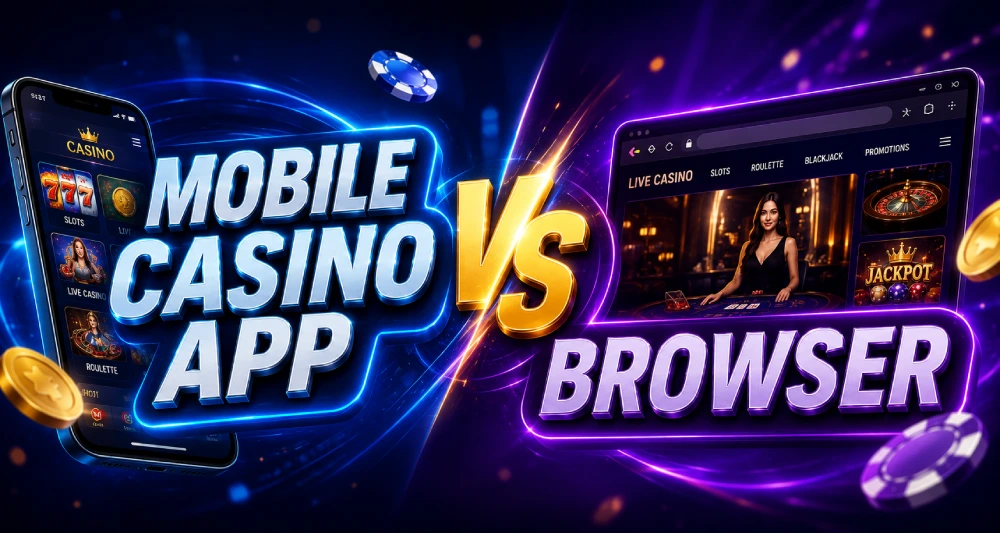
A mobile casino app and a browser-based casino are two ways to reach the same gambling service from a phone. An app is software installed on the device, while browser access loads the site through Chrome, Safari or another mobile browser.
The account works the same way in both. You sign in, access games, check your balance, transact and manage settings. What differs is installation, storage, updates, compatibility, notifications and how the interface is delivered. Nothing about the choice changes your account, the game rules, or the operator behind them.
That extends to the law. The Gambling Regulatory Authority (GRA) states that Singapore Pools is the only operator licensed by GRA to provide remote gambling services in Singapore, and unlicensed remote gambling supplied from Singapore or overseas to people here is unlawful. An app icon and a browser tab are both doors into the same service.
For the broader topic, read our Online Gambling Singapore Guide.
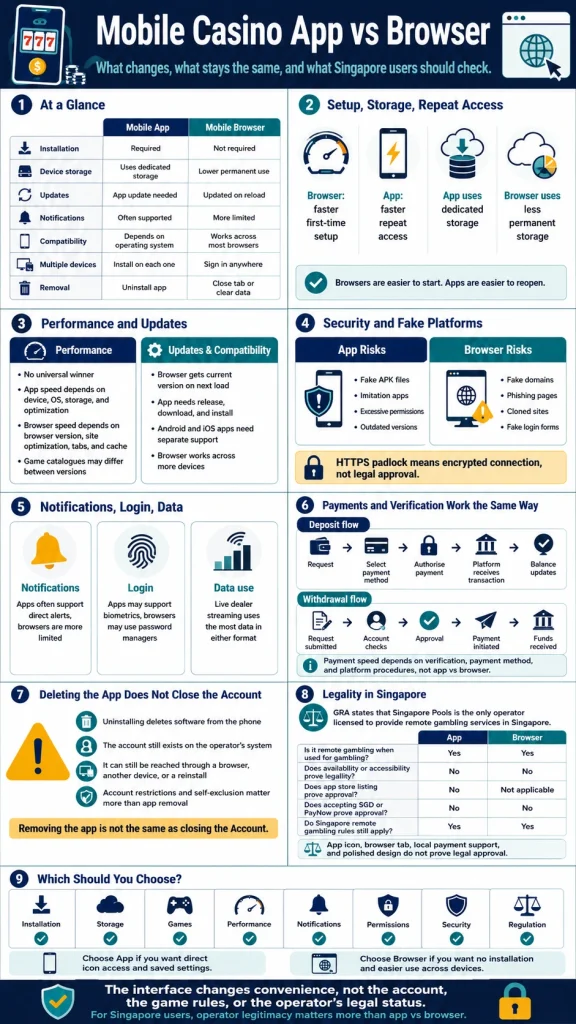
Mobile Casino App vs Browser at a Glance
| Factor | Mobile Casino App | Mobile Browser |
|---|---|---|
| Installation | Required | Not required |
| Device storage | Uses dedicated storage | Lower permanent use |
| Updates | App update needed | Updated by operator on reload |
| Notifications | Often supported | More limited |
| Compatibility | Depends on operating system | Works across most browsers |
| Multiple devices | Install on each one | Sign in anywhere |
| Removal | Uninstall app | Close tab or clear data |
Setup, Storage and Repeat Access
Browser access takes fewer steps to start: open browser, visit site, sign in. An app requires finding it, verifying the source, downloading, installing, then signing in.
After setup the balance shifts. An installed app reopens in one tap, while browser access means navigating to the address each time. Browsers win on first-time setup, apps win on repeat access, which is why the answer depends on how often you use the service.
Storage follows a similar pattern. An app occupies dedicated space for files, images, cache and updates. A browser also caches, but that cache is shared across all browsing rather than reserved for one gambling application.
Performance and Game Access
There is no universal winner on performance. App speed depends on device hardware, operating system, optimisation and available storage. Browser speed depends on browser version, site optimisation, open tabs and cached data. A well-built mobile site regularly outperforms a poorly maintained app, and the reverse is equally true.
Game selection can genuinely differ, which surprises people. Availability depends on operating system compatibility, screen size, browser technology, streaming support and game-provider integration. A casino might offer a title in its browser version but not in an older app release. Compare the actual catalogue rather than assuming both match.
Live dealer games depend on stable streaming in either format, since the video is the game. RNG games load graphics and interface controls instead, which an app may cache locally while a browser retrieves more per session.
For a comparison of live dealer and software-based games, read Live Casino vs RNG Games.
Updates and Compatibility
Browser access has a clear edge on updates. When an operator changes its site, users get the current version on the next page load. An app needs a version released, downloaded, installed and reopened, and some devices leave that to the user.
This matters beyond convenience, since an outdated app can create compatibility or security issues once the operator stops supporting that version.
Compatibility also splits along operating system lines. An Android app does not run on iOS, so an operator must build and maintain both. Browser access sidesteps most of this, though the site still needs testing across screen sizes and browser engines.
Security, Permissions and Fake Platforms
Neither format is automatically safer. Each carries its own failure modes.
For apps, check where the file came from, who publishes it, what permissions it requests, and whether it receives updates. An unofficial APK from an unknown source is a materially different risk from a verified store listing. App-specific scams include fake APK files, imitation applications and malicious permission requests.
For browsers, check the domain spelling, the HTTPS connection, the login page and any redirect behaviour. Browser-specific scams include fake domains, phishing pages, cloned sites and fake login forms.
Permissions deserve attention in both. Apps may request notifications, camera, photos, location or storage access. Some have a clear purpose, such as a camera for identity verification, while others do not match the app’s function. Browsers request similar permissions at browser level, and closing a site does not necessarily revoke what you granted earlier.
One caveat worth stating plainly: an HTTPS padlock confirms the connection is encrypted, not that the operator is licensed. Fraudulent sites use the same certificates as legitimate ones.
For website-level checks, read How to Verify an Online Casino.
Notifications, Login and Data Use
Apps provide more direct notification support, covering account activity, payment status, security alerts and promotions. Worth separating the useful from the unwanted: security and payment alerts help, while promotional pushes are designed to bring you back to the platform. Review notification preferences rather than accepting everything by default.
On login, apps often support biometric authentication while browsers support saved credentials and password managers. Neither should override basic account security on a shared device.
Data use depends on activity rather than access method. Live casino streaming consumes far more than either format’s interface loading, because continuous video dwarfs everything else.
Payments and Verification Work the Same Way
The access method does not change how money moves.
Deposit: Request > Payment method selected > Payment authorised > Platform receives transaction > Balance updates
Withdrawal: Request submitted > Account checks > Approval > Payment initiated > Funds received
An app might open a banking application through a deep link while a browser redirects to a payment page, but the payment provider handles the transfer either way. Withdrawal timing depends on verification, payment method and platform procedures, not on which interface submitted the request.
Verification is identical too. Identity, age, account details and payment ownership are requested by the platform regardless of format. Only the submission mechanics differ.
For more detail, read How Online Casino Deposits Work.
Deleting the App Does Not Close the Account
This is the most consequential misunderstanding in the comparison.
Removing an app deletes software from a device. The account continues to exist on the operator’s system, still reachable through a mobile browser, a desktop browser, another device, or a fresh install. For anyone uninstalling an app to limit their own gambling, that gap is the whole problem: the barrier is one download or one URL away from being gone.
Responsible gambling controls work differently because they attach to the account rather than the device. Spending limits, restrictions, self-exclusion and account closure persist no matter what is installed. NCPG provides self-exclusion covering Singapore Pools account-related services, where existing holders lose access and excluded individuals cannot open a new account while the exclusion is active.
Device removal and formal account restriction are not the same action, and only one of them holds.
For the dedicated guide, read Responsible Gambling Singapore.
Neither Format Proves Legality in Singapore
Using a mobile device does not create a separate legal category. Whether gambling happens through an app, a mobile browser or a desktop, the question is whether the service is licensed under Singapore law.
App store presence is not evidence of approval, since platform distribution rules and Singapore gambling licensing are separate matters. The same goes for user reviews, download counts, polished design or local payment options. Browser accessibility proves nothing either, and the framework covers remote gambling where facilities sit outside, or partly outside, Singapore.
| Question | Casino App | Mobile Browser |
|---|---|---|
| Is it remote gambling when used for gambling? | Yes | Yes |
| Does availability or accessibility prove legality? | No | No |
| Does app store listing prove approval? | No | Not applicable |
| Does accepting SGD or PayNow prove approval? | No | No |
| Do Singapore remote gambling rules still apply? | Yes | Yes |
The access method never changes the operator’s licensing status.
For more detail, read Is Online Gambling Legal in Singapore?
Which Should You Choose?
| Factor | What to Check |
|---|---|
| Installation | Do you want dedicated software on your device? |
| Storage | How much space is available? |
| Games | Are the same titles available in both versions? |
| Performance | Which version runs better on your device? |
| Notifications | Do you want gambling alerts on your phone? |
| Permissions | What device access is being requested? |
| Security | Is the source or domain verified? |
| Regulation | Is the operator permitted in your location? |
An app suits someone wanting direct icon access and saved settings. Browser access suits someone wanting no installation, lower storage use and easy switching between devices.
Only the top half of that table concerns the app-versus-browser choice. Regulation and security apply to the operator regardless, and matter considerably more than the interface.
Common Misconceptions
"Casino apps are always faster."
Not necessarily. Performance depends on the app, the site, the device, the connection and the game technology.
"Browser casinos are less secure."
Not automatically. A legitimate HTTPS site on an updated browser can be safer than an unofficial application file.
"An app store listing means the casino is legal."
Incorrect. App distribution and Singapore gambling licensing are separate matters.
"Deleting the app closes my account."
Incorrect. The account lives on the operator’s system and stays reachable through any browser or a reinstall.
"Using a browser changes the gambling rules."
No. Account terms, game rules and regulatory status attach to the operator, not the access method.
Frequently Asked Questions
What is the difference between a mobile casino app and browser?
An app is installed on your device, while browser access loads the site through a mobile web browser. The differences are installation, storage, updates, notifications and device integration.
Is a casino app better than a mobile website?
It depends on use. Apps offer faster repeat access and device integration, while browsers avoid installation and work more easily across multiple devices.
Does a casino app use more storage than a browser?
Generally yes. An app uses dedicated storage for its files and cache, while browser data is shared across all browsing.
Are casino apps safer than browser casinos?
Neither is automatically safer. App source, domain authenticity, device security, updates and operator legitimacy all matter more than the format.
Is mobile casino gambling legal in Singapore?
The access method does not determine legality. GRA states that Singapore Pools is the only operator licensed by GRA to provide remote gambling services in Singapore, and unlicensed services supplied to people here are unlawful.