Skip to content
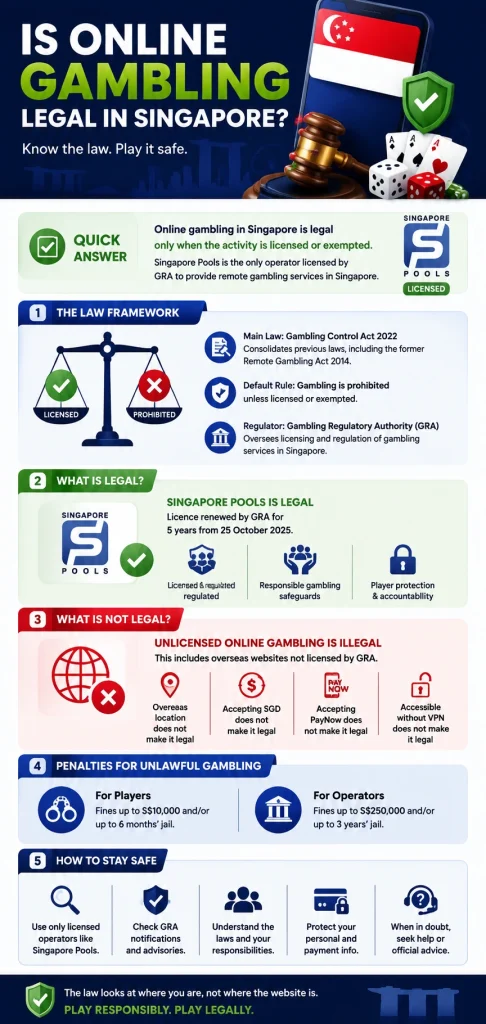
Online gambling in Singapore is legal only when the activity is licensed or exempted. The Gambling Regulatory Authority (GRA) states that gambling is prohibited unless licensed or exempted, whether online or at a physical venue.
For remote gambling, Singapore Pools is the only operator licensed by GRA to provide remote gambling services in Singapore. Its licence was renewed for five years from 25 October 2025 under Section 54 of the Gambling Control Act 2022.
The practical consequence is worth stating plainly: a gambling website being accessible from Singapore tells you nothing about whether it is legal to use. Accessibility is a technical fact, not a regulatory one.
For a broader introduction to the topic, read our Online Gambling Singapore Guide.
Quick Answer
Is online gambling legal in Singapore? Yes, but only within a tightly controlled framework.
Singapore Pools holds the licence covering approved betting operations, gaming and lotteries. Any other remote gambling service supplied to people in Singapore without the required licence falls outside that framework.
Singapore law also reaches overseas operators, covering gambling facilities located fully or partly outside Singapore when services are offered to people here. What matters legally is where the user is, not where the server is.
What Law Regulates Online Gambling in Singapore?
The main legislation is the Gambling Control Act 2022, effective 1 August 2022, which consolidated earlier laws including the former Remote Gambling Act 2014 into a single framework covering physical and remote gambling.
The approach rests on one default rule: gambling is prohibited unless licensed or exempted. That is the opposite of a permissive framework, and it puts the burden on the operator to show permission rather than on the regulator to prohibit each new service.
GRA oversees regulated gambling products and licensing, including casinos, lotteries, betting, gaming machine rooms, and certain class-licensed activities.
For the wider legal framework, read Singapore Gambling Laws Explained.
What Counts as Remote Gambling?
Remote gambling means gambling conducted through remote communication rather than requiring physical presence at the same location, and online gambling sits inside this category.
The framework was deliberately drafted to cover gambling facilities located outside Singapore, or only partly within it, so an overseas location alone does not put an operator outside Singapore’s rules.
For a dedicated explanation, read Remote Gambling in Singapore Explained.
Is Singapore Pools Legal for Online Gambling?
Yes. Singapore Pools is the licensed remote gambling operator, with its licence renewed by GRA for five years from 25 October 2025 covering betting operations, gaming and lotteries.
Licensed services also carry obligations that unlicensed offshore sites do not, including responsible gambling requirements such as expenditure and funding limits. The difference is not only permission to operate but the safeguards attached to it.
Are Overseas Online Casinos Legal in Singapore?
No, not by virtue of being overseas. An operator does not become legal because its servers, company, or facilities sit outside the country, since Singapore’s framework explicitly covers cross-border situations.
The only test that matters is whether the operator has legal authority to provide gambling services to people in Singapore. That makes the following claims unreliable:
“Licensed overseas, so legal in Singapore.” “Accepts SGD, so legal.” “Accepts PayNow, so approved in Singapore.” “Accessible without a VPN, so legal.”
None of these substitutes for Singapore licensing. An overseas licence shows a regulatory relationship with another jurisdiction, nothing more.
Does Accepting PayNow Make an Online Casino Legal?
No. Payment method has no bearing on regulatory status.
A site might support bank transfers, cards, or e-wallets without any of that establishing whether the service is licensed here. Payment familiarity creates a false impression of legitimacy, which is why the two questions are worth separating.
There is a practical point in the other direction too. Financial institutions can be directed to block payment transactions linked to unlawful gambling operators, so a payment route working today is no guarantee it will work tomorrow.
For payment comparisons, read PayNow vs Other Payment Methods.
Can Singapore Residents Gamble on Unlicensed Websites?
No, and this is the point most often misunderstood. Singapore’s framework does not treat unlawful gambling as an operator-only issue.
When the Gambling Control framework was introduced, the government stated that unlawful gambling would be an offence for everyone involved, including operators, agents, and individual punters. Enforcement is active rather than theoretical: since 1 January 2025, the Singapore Police Force has handled the blocking of unlawful remote gambling websites, advertising, and payment transactions.
If you are unsure whether a site falls within the permitted framework, GRA’s licensing information is far more reliable than an operator’s marketing claims.
Are Online Casino Games and Sports Betting Legal?
Both follow the same licensing principle, and neither is a legal category in itself.
“Online casino” is a commercial term, not a regulatory one. Whether slots, roulette, or baccarat are permitted depends on whether the specific service is licensed, not on the games offered. Sports betting works identically: Singapore Pools holds the licence covering betting operations, and an offshore sportsbook gains no legal status by accepting Singapore users.
Esports betting is the clearest exception worth knowing. The National Council on Problem Gambling (NCPG) states that esports betting is illegal in Singapore. International sites routinely group esports with traditional sports markets, which makes it easy to assume the legal treatment is the same. It is not.
For a structural comparison between the two categories, read Online Casino vs Sports Betting.
What About Loot Boxes and Chance-Based Prizes?
Not every online game with chance-based features is regulated like a conventional online casino.
GRA operates a class licensing framework covering certain remote games of chance, referring to games with chance-based elements where players might win money, money equivalents, or other things of value, with loot boxes given as an example.
These rules sit separately from the framework for betting and lottery operators, so a game with random rewards is not automatically online casino gambling. Equally, a class licence for a lower-risk activity is not permission to run a casino.
Licensed vs Unlicensed Online Gambling
| Area | Licensed or Permitted Activity | Unlicensed Activity |
|---|---|---|
| Operator status | Licensed or exempted under Singapore framework | No required Singapore permission |
| Regulatory oversight | Subject to applicable Singapore rules | Outside approved framework |
| User participation | Depends on permitted service | Participation is an offence |
| Payment method | Does not determine legality | Familiar payment methods do not make it legal |
| Overseas location | Not decisive | Overseas location does not bypass Singapore law |
| Safeguards | Responsible gambling controls required | No enforceable protections |
Singapore’s approach focuses on whether gambling is licensed or exempted, not on whether a website looks professional or operates abroad.
How to Check Whether an Operator Is Legal
Start with official regulatory information, not the operator’s own claims.
| Question | Why It Matters |
|---|---|
| Who operates the website? | Identifies the actual gambling provider |
| Is the operator licensed in Singapore? | Determines regulatory status |
| What activities does the licence cover? | A licence may apply only to specific services |
| Is remote gambling included? | Physical and remote permissions differ |
| Is the licence current? | Licensing status changes |
| Is the site relying only on an overseas licence? | Overseas licensing does not replace Singapore approval |
| Does the site make unclear legal claims? | Marketing is not regulatory evidence |
A logo, footer statement, or foreign licence number is not verification. The only reliable source is GRA.
For a broader website checking process, read How to Verify an Online Casino.
Why Singapore Regulates Remote Gambling
Singapore’s approach balances controlled access against harm reduction, permitting selected regulated activities while restricting the rest.
NCPG provides responsible gambling information, exclusion programmes, and support services. Its self-exclusion system covers Singapore Pools online betting alongside casinos and jackpot machine rooms at private clubs, so an individual can bar their own access to the licensed channel.
That safeguard exists only because the activity is regulated. Self-exclusion, spending limits, and account controls have no equivalent on an unlicensed offshore site, which is a practical reason the distinction matters beyond legality alone.
For more information, read Responsible Gambling Singapore.
Common Misconceptions
"If the website accepts Singapore players, it must be legal."
Incorrect. A site’s willingness to accept users says nothing about its licence status.
"If it accepts SGD or PayNow, it is approved."
Incorrect. Payment options and gambling licensing are entirely separate issues.
"An overseas licence makes the casino legal in Singapore."
Incorrect. Singapore applies its own requirements to services supplied to people located here.
"Only the operator breaks the law."
Incorrect. Participation in unlawful gambling is also an offence.
The site is still accessible, so it must be permitted."
Incorrect. Accessibility is never a legal test. A site reachable today may be blocked tomorrow, and blocking status is not a licensing indicator either way.
Frequently Asked Questions
Is online gambling legal in Singapore?
Online gambling is permitted only within Singapore’s licensed or exempted framework. Singapore Pools is currently the operator licensed by GRA to provide approved remote gambling services.
Are online casinos legal in Singapore?
A casino website is not legal simply because it is accessible. The specific service must fall within Singapore’s licensing or exemption framework.
Is overseas online gambling legal for Singapore players?
No. A foreign licence or overseas location does not make a service legal here. Singapore’s framework covers remote gambling supplied from overseas to people located in Singapore.
Is Singapore Pools legal for online betting?
Yes. GRA renewed Singapore Pools’ licence for five years from 25 October 2025, covering approved betting operations, gaming and lotteries.
Is esports betting legal in Singapore?
No. NCPG states that esports betting is illegal in Singapore.