Skip to content

Online gambling works by moving traditional gambling activities onto websites and mobile apps. Users create an account, choose a gambling product, place a stake, receive an outcome, and have any winnings or losses reflected in their account balance.
The most useful thing to understand upfront is that these stages run on separate systems. A payment can succeed while an account balance stays unchanged, and a withdrawal can be approved while the money is still in transit. Most confusion about how online gambling works comes from assuming these steps happen as a single event.
For Singapore users, understanding the process also means understanding local rules. The Gambling Regulatory Authority (GRA) states that Singapore Pools is the only operator licensed by GRA to provide remote gambling services in Singapore. Participating in unlicensed remote gambling is an offence.
If you are starting with the broader topic, read What Is Online Gambling? first.
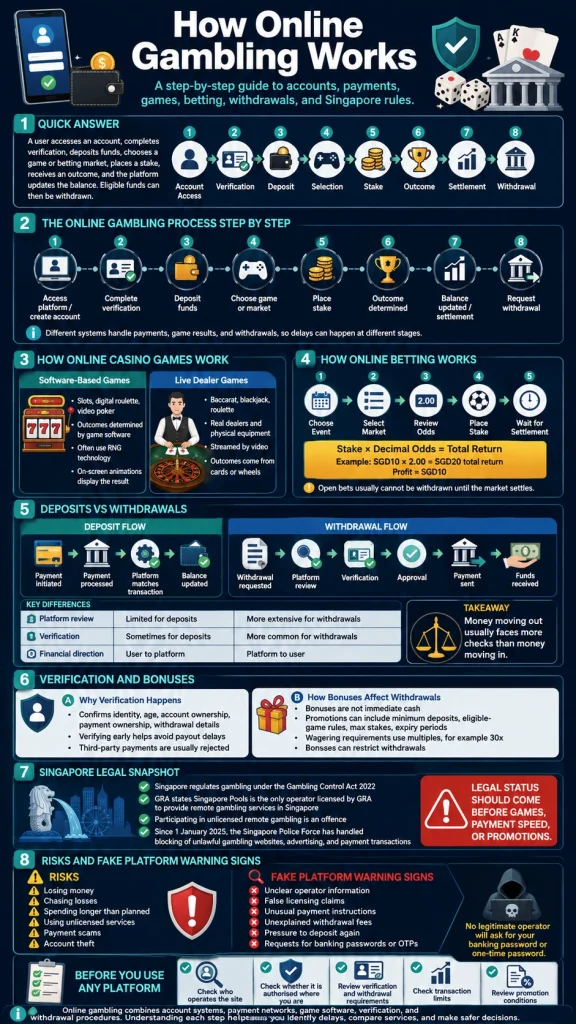
Quick Answer
How does online gambling work? A user funds an account, chooses a game or betting market, selects a stake, and receives an outcome. The platform records the result and adjusts the balance.
The online gambling process looks like this:
Account access > Verification > Deposit > Game or bet selection > Stake > Outcome > Settlement > Withdrawal
Casino games, live dealer games, sports betting, and lottery products each determine outcomes differently, so the middle of that sequence varies.
For a broader overview of the topic cluster, see the Online Gambling Singapore Guide.
The Online Gambling Process Step by Step
Step 1: Accessing a Platform and Creating an Account
Registration typically asks for name, date of birth, contact details, login credentials, and payment information. The account then acts as the central record for deposits, wagers, results, withdrawals, and verification status.
Website access alone does not prove an operator is authorised in Singapore. GRA states that providing unlicensed remote gambling services to people in Singapore is unlawful, whether the service originates locally or overseas.
Step 2: Completing Verification
Verification confirms the account belongs to the person using it, covering identity, age, account ownership, payment ownership, and withdrawal details.
Some platforms verify at registration, others defer it. Where deferred, it almost always resurfaces at the withdrawal stage, which is why an account can feel fully functional until the first payout request. Verifying early is the best way to avoid withdrawal delays.
For a detailed explanation, read How to Verify an Online Casino.
Step 3: Depositing Funds
Common payment categories include bank transfers, real-time payments, cards, and e-wallets.
A deposit involves two processes: the payment provider processes the payment, then the platform identifies the transaction and credits the account. This is why a bank can show a successful payment before the balance updates. The bank has finished its job, but the platform has not yet matched the payment to your account.
For the full process, read How Online Casino Deposits Work.
How Online Casino Games Work
Understanding how online casinos work means separating two categories.
Software-Based Casino Games
Games such as online slots, digital roulette, and video poker run through software that applies predefined rules to each wager, commonly using random number generator technology.
The graphics on screen represent a result the system has already determined. Spinning reels and flipping cards are animations of that result, so no button-press timing influences the outcome.
Live Dealer Casino Games
Live baccarat, blackjack, and roulette use real dealers and physical equipment streamed by video, with players submitting wagers through the interface.
The key difference is the source of the outcome. RNG games use software, while live outcomes come from physical cards or wheels, and live games run at the dealer’s speed with fixed betting windows.
Read Live Casino vs RNG Games for a direct comparison.
How Online Betting Works
Online betting means wagering on real events: choose an event, select a market, review the odds, place a stake, and wait for settlement.
Decimal odds of 2.00 on a SGD10 successful wager return SGD20 in total:
Stake x Decimal Odds = Total Return
That total includes your stake, so the profit is SGD10, not SGD20. Odds are also not a guarantee of an event’s real chance, since the price includes the operator’s margin.
Funds committed to an open bet are usually unavailable for withdrawal until the market settles, so account balance and withdrawable balance are not always the same.
For more detail, read Online Casino vs Sports Betting.
How Results Are Settled and What RTP Means
Settlement is where the platform decides whether a wager won or lost and updates the balance. Slots settle immediately, live games settle once the physical outcome is confirmed, and sports bets stay open until the market reaches a result. Bets may be voided under operator rules, such as an abandoned match, in which case the stake is returned.
RTP, or return to player, is a theoretical percentage describing how much a game is designed to return across a large number of wagers, often calculated across millions of rounds. A 96% RTP does not mean a player receives SGD96 after wagering SGD100 once. Individual sessions land far above or below it, and no game is ever “due” for a payout.
What Happens When You Request a Withdrawal?
Withdrawals involve more steps than deposits:
Withdrawal request > Platform review > Verification > Approval > Payment sent > Funds received
Review checks might include account verification, payment ownership, withdrawal limits, and transaction history. Once approved, the payout runs at the speed of the payment network, so total wait time combines review and banking time.
| Stage | Deposit | Withdrawal |
|---|---|---|
| Platform review | Usually limited | Often more extensive |
| Account verification | Sometimes | More common |
| Financial transfer | User to platform | Platform to user |
| Balance update | After crediting | After approval and payment |
Money moving in faces fewer checks than money moving out. That asymmetry is a feature of the review process, not a sign something has gone wrong.
For a full explanation, read How Online Casino Withdrawals Work.
Why Payment Verification Happens
Payment verification is separate from payment processing. A bank transfer can succeed while the platform still needs to verify it. The most common trigger is a name mismatch between the payment account and the gambling account, which is why third-party payments are usually rejected.
Read Payment Verification Issues Explained for troubleshooting.
How Bonuses Affect the Process
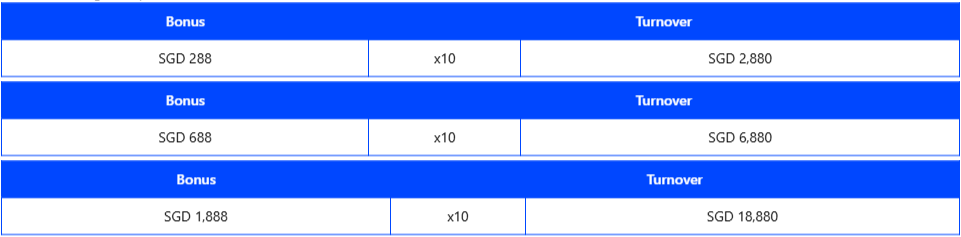
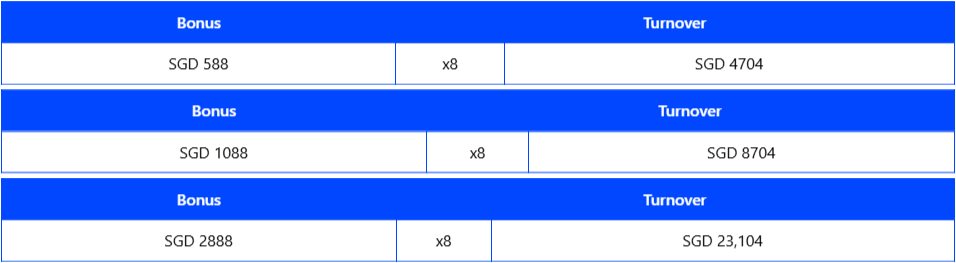
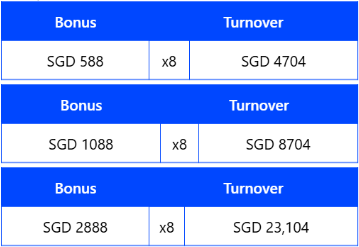
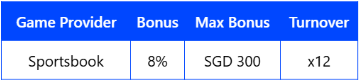
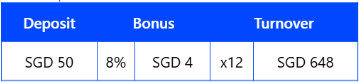
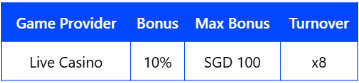
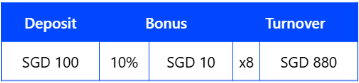
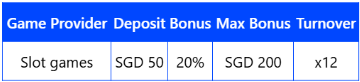
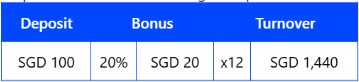
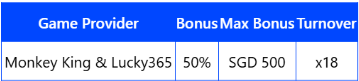
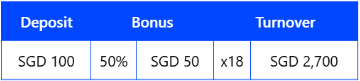
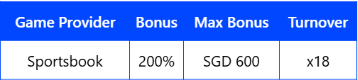
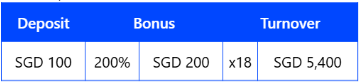
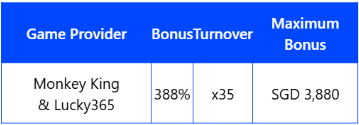
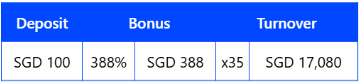
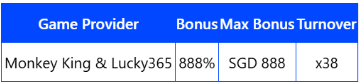
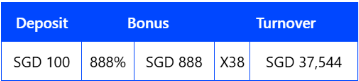
A bonus is not cash available for immediate withdrawal. Promotions carry conditions such as minimum deposits, eligible-game restrictions, maximum stakes, and expiry periods. Wagering requirements are expressed as a multiple, so a 30x requirement means wagering thirty times the relevant amount before withdrawal is possible. Accepting a bonus can also restrict withdrawals on funds that were previously unrestricted.
Is Online Gambling Legal in Singapore?
Singapore regulates gambling under the Gambling Control Act 2022, administered by GRA. The Act took effect on 1 August 2022, consolidating earlier legislation including the former Remote Gambling Act 2014.
GRA states that Singapore Pools is the only operator licensed by GRA to provide remote gambling services in Singapore. Providing unlicensed remote gambling services to people in Singapore is unlawful, and participating in unlicensed remote gambling is also an offence.
Enforcement is active. Since 1 January 2025, the Singapore Police Force has handled the blocking of unlawful gambling websites, advertising, and payment transactions. What matters legally is where the user is located, not where the server is, so an overseas website is not outside Singapore’s rules.
For more detail, read Is Online Gambling Legal in Singapore?
Risks and How to Spot a Fake Platform
Common risks include losing money, chasing losses, spending longer than intended, using unlicensed services, payment scams, and account theft. Mobile access removes the physical boundary of leaving a venue, which makes session length and spending easier to lose track of.
A fake platform can display games, balances, promotions, and withdrawal buttons that look entirely normal, but a displayed balance is just a number with no funds behind it. This is why problems surface at the withdrawal stage rather than during gameplay.
Warning signs include unclear operator information, false licensing claims, unusual payment instructions, unexplained withdrawal fees, pressure to deposit again, and requests for banking passwords or OTPs. No legitimate operator will ever ask for a banking password or a one-time password.
Singapore’s National Council on Problem Gambling provides responsible gambling information, exclusion tools, and support services.
Before You Use Any Platform
Online gambling is not one technical process. Account systems, payment networks, gaming software, verification, and withdrawal procedures all work together, and a delay at any one stage looks identical to a delay at another from the user’s side.
Before depositing anywhere, check who operates the site, whether it is authorized where you are, the verification and withdrawal requirements, transaction limits, and promotion conditions. For Singapore users, legal status should come before games, payment speed, or promotions.
Frequently Asked Questions
How do online casinos work?
Software-based games use game systems and RNG technology to determine outcomes, while live dealer games use physical tables streamed to players online.
Why does my deposit show as paid but not appear in my balance?
The bank and the platform run separate processes. A bank can confirm a payment has left your account while the platform is still matching that transaction, so the balance updates only after matching completes.
Why do withdrawals take longer than deposits?
Withdrawals add a platform review and verification stage before payment is released, then run at the speed of the chosen payment network.
Is online gambling legal in Singapore?
GRA states that Singapore Pools is currently the only operator licensed by GRA to provide remote gambling services in Singapore. Participating in unlicensed remote gambling is an offence.
What should I do if my PayNow payment is missing?
First check whether the bank shows the transfer as completed. Save the transaction reference and contact the receiving platform if the payment has not been credited after its stated processing time.